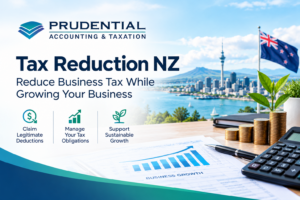
Yes, you can do both. The key is to claim every legitimate deduction, invest in assets that move the business forward, and plan your provisional tax before IRD’s dates catch you out.
Most companies in New Zealand pay income tax at a flat 28%, according to Inland Revenue, so eligible business expenses can reduce taxable income, although some costs are treated differently for tax purposes. But tax reduction in NZ isn’t about spending money just to save tax. It’s about claiming properly what you were already going to spend, and making sure a good year doesn’t leave you with a bill you can’t pay. Here’s how to get there.
Key Takeaways
- A deduction reduces your tax, not your cost. Spending $1 to save 28 cents still leaves you 72 cents worse off.
- Keep records for genuine business costs, and claim only the business portion of mixed-use items like your phone, car and home office.
- Investment Boost lets you deduct 20% of the cost of most new business assets upfront (from 22 May 2025).
- Provisional tax starts once your residual income tax passes $5,000, and a growing business is often caught short.
- Reviewing your tax position during the year gives you more time to plan for the tax you may need to pay.
Can You Reduce Business Tax While Still Growing?
You can, provided your tax decisions are based on legitimate business expenses and sound financial planning.
For example, imagine a South Auckland trades business has had a stronger year than expected. The owner is looking at the projected tax bill and starts thinking about buying equipment before the end of the tax year.
The equipment may be useful for the business. It could improve productivity, help the business take on more work, or replace something that is no longer reliable.
That is a different decision from buying an unnecessary piece of equipment just because “it will reduce my tax”.
The first decision is a business investment that may also have tax consequences. The second can simply reduce the owner’s cash without creating enough business value in return.
In New Zealand, businesses are generally taxed on their income after allowable business expenses and other deductions are taken into account.
The question, then, is not simply “How can I pay less tax?” It is:
“How can I use my business money in a way that supports growth while making sure I claim the deductions I’m entitled to?”
Business Tax Deductions NZ Owners Miss Most Often
Everyday costs and mixed-use items
Many ordinary business costs can be deductible when they are incurred in earning business income. These can include costs such as rent, wages, insurance, software, advertising, accounting fees and stationery, depending on the circumstances. Mixed-use costs need particular care because only the business-related portion may be claimable. Here’s a quick guide:
| Expense | Claimable? | What to watch |
| Software, subscriptions, stationery | Yes | Must be for business use |
| Phone and internet | Business portion | Keep bills and work out your split |
| Vehicle costs | Business portion | Logbook or IRD mileage rate |
| Home office | Share of running costs | Based on space used for work |
| Business meals and entertainment | Depends on the expense | Some entertainment expenses are 50% deductible, while others may be fully deductible |
| Equipment and machinery | Via depreciation or Investment Boost | Not a one-off expense unless it’s low-value |
| Fines and private spending | No | Never deductible |
Keep your records tidy
Inland Revenue requires businesses to keep relevant tax records for seven years. Keep receipts, invoices and other supporting records as you go rather than trying to reconstruct your expenses at the end of the year. Keeping your records organised makes it much easier to identify legitimate business tax deductions NZ claims and support them if Inland Revenue asks for evidence.
How Does Tax Planning Help a Growing Business?
Business tax planning is about looking ahead and not waiting until the end of the tax year to know what the tax bill is.
For a growing business, that can mean reviewing:
- Your expected profit for the year
- Big purchases you’re planning
- Expenses that haven’t been recorded yet
- Depreciation on your assets
- What you owe in GST
- Your provisional tax payments
- How much cash you can put towards growth
- Any changes to staff or contractors
- Whether your business structure still fits
- Whether your current spending is actually paying off
For example, if profits are growing rapidly, tax requirements may increase in the future. In New Zealand, provisional tax laws normally apply to enterprises that had residual income tax of more than $5,000 in the previous year. Some special conditions and restrictions may apply.
Planning for that liability can help prevent a profitable business from suddenly facing a cash-flow problem.
What are the Best Ways to Reduce Business Tax in NZ Legally?
There is no single tax-saving strategy that works for every New Zealand business. A sensible approach is to work through the basics first.
1. Keep track of legitimate business expenses
Do not overlook genuine costs simply because records have not been organised.
2. Review major purchases before making them
Before you spend big, work out what the purchase will do for the business and how it’ll be treated for tax.
3. Keep business and private spending separate
Clear separation makes bookkeeping and tax reporting easier.
4. Plan for upcoming tax payments
Set aside money for tax rather than treating the full bank balance as available for spending.
5. Review your business structure when circumstances change
The structure that suited you when the business was starting won’t always fit as profits, risks and plans change.
6. Look at tax alongside cash flow
A lower tax bill is not useful if the business cannot comfortably meet its other financial commitments.
When Should You Get Professional Tax Advice?
You do not necessarily need complicated tax planning every time you buy a business expense.
However, professional advice can be useful when:
- Your business profits have increased significantly
- You are considering a major asset purchase
- You are hiring employees
- You are changing business structure
- You are expanding the business
- You have significant tax payments approaching
- You are unsure whether an expense is deductible
- Business and personal expenses have become difficult to separate
Prudential Accounting and Taxation works with businesses on tax, accounting, forecasting and business planning, helping business owners understand how financial decisions may affect both their tax position and wider business finances.
Want To Reduce Tax While Growing Your Business?
Smart tax planning is not about spending money just to reduce your tax bill. It is about understanding your deductions, planning and making business decisions that support both your tax position and your growth.
Prudential Accounting and Taxation can help you review your tax position, identify legitimate opportunities and plan with greater clarity.
Call Us Today On (09) 298 7291
FAQ’S
Can I Reduce My Business Tax Without Slowing Growth?
Yes. Tax planning should be about claiming legitimate deductions and making sensible investment decisions, not spending money just to shrink your taxable income. Look at your expected profit and upcoming expenses first, and it becomes much easier to decide where your money is best spent.
What Business Expenses Can I Claim As Tax Deductions In NZ?
Lots of everyday business costs can be claimed as deductions, like accountant fees, supplies, rent, repairs, and some car or home-office costs. Whether you can claim something depends on what it is and whether it helps you earn business income.
Should I Spend More To Reduce My Business Tax?
Not necessarily. A tax reduction in NZ does not make an expense free. If your business does not need something, buying it purely for a tax deduction may leave you with less cash than you started with. The purchase should make commercial sense first.
How Can I Reduce Business Tax In NZ Legally?
You can reduce business tax in NZ by claiming legitimate business deductions, applying the correct treatment to business assets, planning the timing of eligible expenses and reviewing your tax position throughout the year. Good records are also important for supporting your claims.
How Does Provisional Tax NZ Affect Business Growth?
As your profits grow, provisional tax in NZ can start to squeeze your cash flow. If your residual income tax from the previous year was more than $5,000, you’ll generally need to pay it. Planning for those payments early means your tax bill won’t end up competing with the money you need to grow the business.