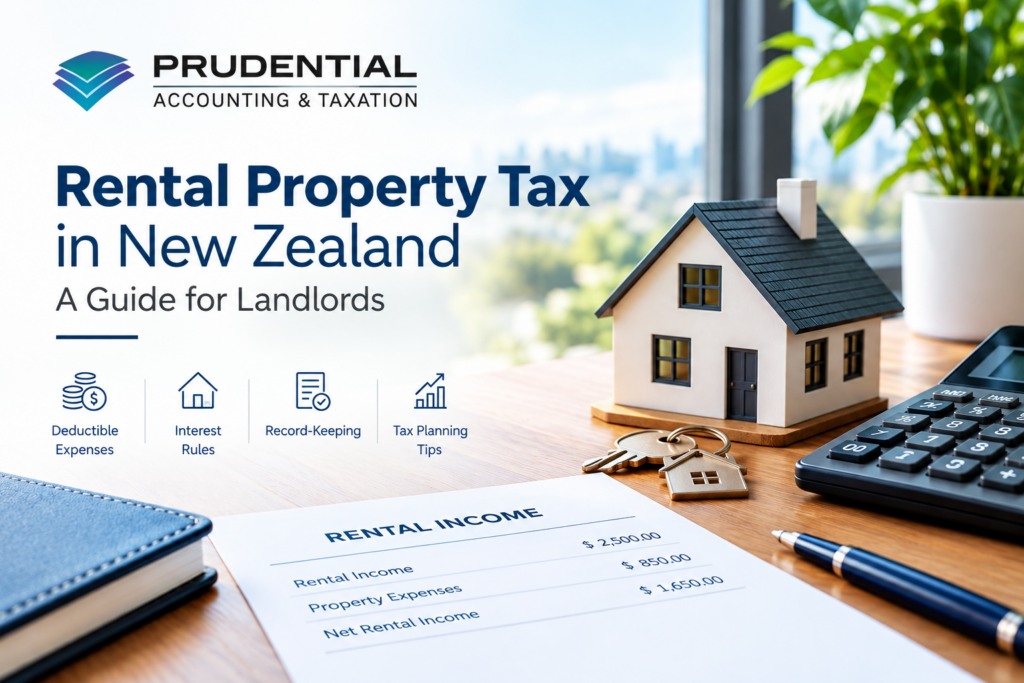
Managing rental property tax gets a lot easier when you know what income to declare, which expenses you can claim, and what records you need to keep.
You collect the rent each week. The mortgage goes out. Then there are rates, insurance, repairs, property management fees and the occasional unexpected maintenance bill.
By the end of the financial year, it can be difficult to know which costs actually affect your tax position.
That is where good record-keeping makes a difference. You do not need to be a tax professional, but yes, you should have a basic understanding of how rental property tax works in New Zealand.
Key Takeaways
- Rental income usually appears on your income tax return.
- Some rental property expenses may be deductible, while capital improvements are generally treated differently.
- Qualifying residential rental property interest is generally 100% deductible from 1 April 2025, subject to the relevant rules.
- Ring-fencing rules stop you from using a residential rental loss to reduce the tax on your wages or salary.
- Rental property records typically require to be kept for at least seven years.
- Repairs, improvements, private use and short-stay accommodation can all affect the tax treatment.
Why Rental Property Tax Needs More Attention Than Owners Expect
The rules for residential property tax have altered over recent years, particularly the restrictions around interest deductibility and the bright-line test. That makes it worth checking that advice you received several years ago still applies.
If you set up your rental a few years ago and haven’t revisited it since, there’s a good chance your assumptions are out of date.
This matters because interest can be a significant rental property expense, so changes to its deductibility can affect your taxable rental income.
Rental property expenses you can and can’t claim
What’s deductible
Costs incurred in earning rental income may be deductible, provided they meet the relevant tax rules and are not private or capital in nature. These can include:
- Mortgage interest (now fully deductible again, see below)
- Rates, insurance and property management fees
- Repairs and maintenance that restore the property rather than improve it
- Accounting fees for managing your rental’s tax affairs
- Certain Healthy Homes-related costs, depending on whether the work is deductible repairs and maintenance or capital expenditure
What’s not deductible
- Capital improvements, like adding a room or a new deck, which are depreciated (where applicable) rather than claimed outright
- Mortgage principal repayments. (Only the interest portion is counted.)
- Private-use portions, which may need to be excluded or apportioned where a property has both private and income-earning use
| Expense type | Deductible? | Notes |
| Mortgage interest | Yes, 100% | Fully restored from 1 April 2025 |
| Rates and insurance | Yes | Standard holding costs |
| Repairs | Yes | Restoring, not improving |
| Renovations/improvements | No (capitalised) | May be depreciable |
| Property management fees | Yes | Fees paid to agents for managing or collecting rent |
| Healthy homes upgrades | Depends | Check if capital or repair in nature |
Repairs or Improvements: Why Does the Difference Matter?
This is one of those areas that rental owners become most puzzled about.
Suppose a tenant reports a broken window. You replace it with a similar window. That is generally a repair or maintenance issue.
Now imagine you decide to replace all the windows with a substantially different or upgraded system as part of improving the property.
That can be a different tax question.
Repairs and maintenance are handled differently from capital improvements by Inland Revenue, which generally doesn’t allow capital spending to be claimed as a rental expense straight away.
The answer can depend on the nature and scale of the work, the condition of the property beforehand and what the work actually achieves.
So before claiming a large renovation as a repair, check the tax treatment rather than assuming the whole invoice is deductible. If you are not sure, it is best to get tax planning services.
Bright-line Test: What It Means When You Sell Your Rental Property
New Zealand doesn’t have a general capital gains tax, but the bright-line test taxes the profit on a residential property sold within a set period of buying it. For any property sold on or after 1 July 2024, that period is 2 years, regardless of when you originally purchased it. This is a big change from the 10 years (5 years for new builds) that applied to properties bought between March 2021 and mid-2024.
A few points worth knowing:
- The bright-line start date is usually your settlement date, and the end date is when you sign the sale agreement.
- The main-home exclusion has specific conditions. For properties covered by the current rules, these generally include using more than 50% of the property’s area as your main home and living in it as your main home for more than 50% of the bright-line period.
- Profits caught by the test are taxed at your normal marginal rate, up to 39%.
If you’re weighing up whether to sell now or wait, knowing exactly where your bright-line date falls can change the maths significantly.
Rental Property Tax: What Records Should You Keep?
Tax time becomes much easier when your records are organised from the start.
For rental property tax, keep records such as:
- Rental income
- Rates
- Insurance
- Property management statements
- Repair and maintenance invoices
- Mortgage interest statements
- Bank records
- Legal or professional fees
- Asset purchase information
- Other relevant receipts and invoices
Inland Revenue generally requires rental property records to be kept for at least seven years.
Good rental property management is not only about tenants, maintenance and rent collection. It also includes keeping each property’s financial information organised and separate.
That way, when you need to work out your rental property expenses, you are not trying to identify them from a bank account full of personal and property transactions.
How Can You Make Rental Property Tax Easier to Manage?
You do not need to wait until the end of the financial year to go through your rental tax position.
A simple routine can help.
Keep rental income records current
Record rent received and any other income connected with the property.
Save invoices as you receive them
Do not rely on searching through old emails or bank statements months later.
Keep repairs and improvements separate
If a contractor carries out several types of work, keep enough detail to understand what each payment was actually for.
Check your mortgage records
Keep track of qualifying interest and make sure you can identify the borrowing it relates to.
Reconcile regularly
Checking your rental bank transactions against your records can help catch missing or incorrectly recorded expenses.
Review major decisions before making them
Buying another property, refinancing, carrying out a major renovation or changing how you use a property can all affect your tax position.
This is where professional tax planning services can be useful. Instead of only looking at what happened last year, you can consider the tax implications of decisions you are planning to make.
When Should You Get Help With Rental Property Tax?
You may be comfortable managing one straightforward rental property yourself.
But as the situation becomes more complicated, getting advice can save time and help you avoid treating the wrong costs as deductions.
Professional advice can be particularly useful if you:
- Are buying your first rental property
- Own multiple properties
- Are considering refinancing
- Are planning a major renovation
- Use a property partly for private purposes
- Have moved from long-term renting to short-stay accommodation
- Are considering selling
- Have carried-forward rental losses
- Are unsure whether a particular expense is deductible
At Prudential Accounting and Taxation, we help property owners make sense of their rental income, expenses and wider tax position rather than simply looking at the numbers once a year.
Before Your Next Property Decision, Know the Tax Impact
Buying, refinancing, renovating or selling a rental property can affect more than your monthly cash flow. A quick review of your numbers and tax position can help you understand the potential implications before you commit.
Prudential Accounting and Taxation can help you review your rental property figures, identify relevant tax considerations and plan for what comes next.
Review My Property TaxFAQ'S
What rental property expenses can I claim in New Zealand?
Depending on your circumstances, deductible expenses can include rates, insurance, property management fees, qualifying interest, repairs and maintenance and certain professional costs. Capital expenditure and private expenses generally have different tax treatment.
Can I claim mortgage interest on my rental property?
From 1 April 2025, qualifying interest on residential rental property is generally 100% deductible, subject to the normal deductibility rules and any applicable exclusions or exemptions.
Can rental losses reduce my salary income?
Generally, no. Residential rental losses are subject to ring-fencing rules, so excess deductions generally cannot be used to reduce salary, wages or other non-rental income. They are generally carried forward for use against future residential rental income.
How long should I keep rental property records?
Rental property records generally need to be kept for at least seven years. This can include rental income records, invoices, receipts, bank statements, loan information and supporting tax calculations.
Do I pay GST on residential rental income?
Ordinary long-term residential rental income is generally exempt from GST. Short-stay accommodation can have different GST treatment depending on the circumstances.