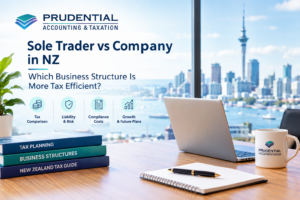
A client walked into our office last year making $95,000 as a sole trader, convinced that switching to a company would cut his tax bill straight away. It wouldn’t have, not at that income level, and once we ran his numbers he understood why.
Sole trader vs company NZ is one of the most common questions we field, and it rarely has a one-size answer. It comes down to how much you earn, how you plan to use your profit, and how much paperwork you’re willing to carry.
Below is how the two structures really stack up, based on actual figures rather than the generic advice most people repeat online.
Key Takeaways
- Companies pay a flat 28% tax rate on profit. Sole traders pay personal tax rates that climb to 39% once income passes $180,000.
- Under roughly $78,100 in profit, sole trader tax is often similar to, or lower than, company tax.
- A company keeps business debt separate from your personal assets. A sole trader carries that risk directly.
- Running a company costs more: annual returns, separate accounts, tighter compliance.
- The right business structure NZ owners should choose depends on profit and risk, not on which option sounds more impressive.
What’s the Difference Between a Sole Trader and a Company?
A sole trader and their business are legally the same thing. A company is a separate legal entity, registered with the Companies Office, that owns and runs the business on its own.
That one distinction shapes everything else:
- As a sole trader, your business profit is your personal income, taxed at your personal rate.
- As a company owner, the company pays its own tax first. You’re taxed again, separately, on whatever salary or dividends you take out.
- A sole trader is personally on the hook for business debt. A company usually isn’t, within limits.
Choosing between sole trader or company NZ setups really means choosing a legal structure first, and a tax outcome second.
How Does Sole Trader Tax Actually Work?
Sole trader tax runs on the same progressive brackets as personal income tax, because your profit simply gets added to whatever else you earn. Higher profit pushes more of your income into higher brackets.
The current IRD rates:
- 10.5% on income up to $15,600
- 17.5% on income from $15,601 to $53,500
- 30% on income from $53,501 to $78,100
- 33% on income from $78,101 to $180,000
- 39% on income above $180,000
These apply progressively, so you’re not paying the top rate on everything you earn, only on the slice that sits inside each bracket. You can check the live figures on IRD’s tax rates for individuals page.
How Does Company Tax Work, and Where’s the Saving?
A New Zealand company pays a flat 28% on its profit, no matter how large that profit gets. That flat rate is where most “companies save tax” claims come from, and it’s only half the picture.
Here’s what actually happens once profit lands in a company:
- The company pays 28% tax on its profit first.
- Any salary you draw is then taxed at your personal rate, same as an employee.
- Dividends usually come with imputation credits attached, so the tax already paid at company level isn’t charged twice.
- Profit left inside the company, not drawn out at all, is only taxed at that 28% rate for the year.
The real saving shows up when profit stays in the company for reinvestment. Draw everything straight back out as salary and dividends, and the total tax often lands close to what a sole trader would pay anyway.
Sole Trader vs Company: A Direct Tax Comparison
Numbers explain this faster than percentages do. Here’s a simplified look at company vs sole trader NZ outcomes across a few profit levels.
| Annual Profit | Sole Trader (Marginal Rate) | Company (Flat Rate) |
| $60,000 | 30% on the top slice | 28% flat |
| $90,000 | 33% on the top slice | 28% flat |
| $150,000 | 33% on the top slice | 28% flat |
| $220,000 | 39% on the top slice | 28% flat |
At lower profit, the gap barely matters, and a sole trader’s average rate across their full income often sits at or below 28% anyway. Past $180,000, and especially once you’re there consistently, the company’s flat rate starts pulling ahead, provided you’re not withdrawing every dollar as soon as it lands.
What Else Changes Besides Tax?
Tax is only one piece of this decision. Liability, admin, and how your business reads to banks and clients matter just as much.
Things worth weighing before you commit:
- Liability: A company generally keeps business debt separate from your personal assets. A sole trader doesn’t have that buffer.
- Compliance: Companies file annual returns and need their own financial statements. Sole trader bookkeeping stays simpler.
- Perception: Some clients and industries prefer contracting with a registered company over an individual.
- Cost: Setting up and running a company costs more than staying a sole trader, year on year.
If you’re weighing this up properly, our Company Formation & Administration service walks through the practical side before you commit either way.
When Does It Make Sense to Switch?
Most sole traders don’t need to switch straight away. It usually makes sense once profit and risk both start climbing.
Signs worth a proper look:
- Profit consistently sits above $80,000 to $100,000 a year.
- You’re taking on contracts with real liability exposure.
- You’re bringing on a partner or investor.
- You want to leave profit in the business to fund growth, rather than draw it all out.
- A bank or larger client has specifically asked for a company structure.
None of these mean a company is automatically the right call. They’re reasons to sit down and run your actual numbers, not follow a rule of thumb someone else picked up online.
Ready to Get a Clear Answer for Your Numbers?
Generic advice on sole trader vs company NZ only goes so far, because the right call depends entirely on your profit, your industry, and where you’re heading. Prudential Accounting works through your real numbers, not just the theory. Talk to us about Tax Planning & Minimisation, get support through Business Planning & Strategy, or contact us to find out which structure actually fits your business.
FAQ’s
Is a company always more tax efficient than a sole trader in NZ?
No. Under roughly $78,100 in profit, a sole trader’s average tax rate often matches or beats the company’s flat 28%. The company’s edge grows as profit climbs, especially past $180,000.
Can I switch from sole trader to a company later?
Yes, plenty of business owners make that move once profit and risk grow. It means registering a company, transferring the business over, and updating contracts, IRD, and GST registration.Lorem ipsum dolor sit amet, consectetur adipiscing elit. Ut elit tellus, luctus nec ullamcorper mattis, pulvinar dapibus leo.
Does a company protect my personal assets completely?
Mostly, but not always. Directors can still be personally liable in some cases, like signing a personal guarantee on a loan or trading while insolvent. It’s protection, not a guarantee.
How much more does it cost to run a company than stay a sole trader?
Expect higher accounting and compliance costs, including annual Companies Office returns and separate financial statements. The exact cost depends on your business size and how much support you need.
What structure suits someone just starting out?
For most people testing a low-risk idea with modest income, sole trader is the cheaper, simpler starting point. It’s worth revisiting once profit and liability exposure start to grow