Most self-employed Kiwis find out what provisional tax NZ actually means the hard way, usually a few months after their first profitable year in business. The IR3 bill lands, and right behind it comes a second bill for tax on income you haven’t even earned yet.
That second bill catches almost everyone off guard the first time. It’s not a penalty and it’s not a mistake on IRD’s part. It’s simply how New Zealand collects tax from anyone whose income isn’t taxed at source through PAYE.
This guide sets out exactly when payments are due, what triggers the obligation, and where business owners lose money through avoidable errors.
Key Takeaways
- You become a provisional taxpayer once your residual income tax (RIT) from the prior year exceeds $5,000.
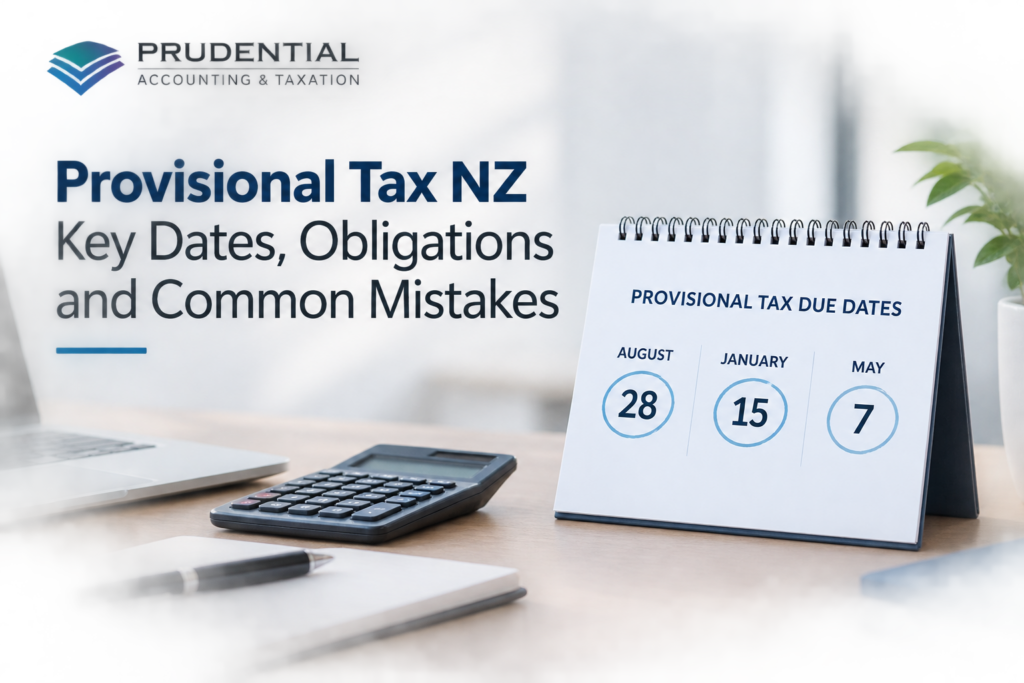
- Standard payments fall on 28 August, 15 January, and 7 May for most businesses.
- Underpaying provisional tax payments NZ currently attracts use-of-money interest of around 8.97% per year.
- The “safe harbour” rule protects taxpayers with RIT under $60,000 from interest charges if they pay the standard amount on time.
- New businesses often owe two years of tax in one year. Planning for this early avoids cash flow shock.
Table of Contents
- What Is Provisional Tax and Who Has to Pay It?
- How Are the Payment Dates Worked Out?
- Which Calculation Method Should You Use?
- What Happens If You Get It Wrong?
- What Is the Safe Harbour Rule?
- Common Provisional Tax Mistakes NZ Business Owners Make
What Is Provisional Tax and Who Has to Pay It?
Provisional tax is income tax paid in instalments during the year, instead of one lump sum after filing. It exists because IRD wants tax collected close to when the income is earned, the same way PAYE works for employees.
You’re pulled into the system once your provisional tax obligations are triggered by RIT over $5,000 in the previous tax year. This usually applies to sole traders, contractors, landlords with untaxed rental income, and companies. Someone on a straight salary almost never pays it, because PAYE already covers that liability throughout the year.
How Are the Provisional Tax Dates NZ Businesses Need to Track Worked Out?
For a standard 31 March balance date, payments are due on 28 August, 15 January, and 7 May. Each instalment covers roughly a third of your estimated tax for the year.
Businesses filing six-monthly GST returns pay in two instalments instead of three. If your balance date isn’t 31 March, your instalment dates shift accordingly, and it’s worth confirming these directly with your accountant rather than assuming the standard calendar applies.
Which Calculation Method Actually Suits Your Business?
Three methods exist, and picking the wrong one is where most of the pain starts.
- Standard method – takes last year’s RIT and adds 5% (or 10% if based on the year before that). Simple, and protected from interest if paid on time.
- Estimation method – you forecast this year’s income yourself. Useful if your income has dropped, but you carry the interest risk if the estimate is too low.
- AIM (Accounting Income Method) – calculates tax from your actual accounting software data as you go. Suits businesses with income that swings month to month.
A tradie with steady, growing income usually does fine on the standard method. A business that’s had a rough year, or one just past a big contract ending, often does better estimating down rather than overpaying on last year’s figures.
What Happens If a Payment Is Missed or Underpaid?
You’ll face use-of-money interest, and possibly late payment penalties on top. IRD confirms the current underpayment rate sits around 8.97% per annum, charged daily from the day after the due date (https://www.ird.govt.nz/updates/news-folder/2025/use-of-money-interest-uomi-rate-change-january-2026).
Miss the due date entirely and a 1% penalty applies the next day, with a further 4% added a week later if it’s still unpaid. These costs stack quickly. A $15,000 shortfall left unpaid for two months can add well over a thousand dollars in interest and penalties combined.
What Is the Safe Harbour Rule and Does It Protect You?
It shields taxpayers with RIT under $60,000 from interest charges, provided they pay the standard method amount by each due date. This is the rule that makes the standard method the default choice for most small businesses.
If your RIT for the year comes in higher than expected, the shortfall is simply squared up at terminal tax time, without interest, as long as the safe harbour conditions were met throughout the year.
Common Provisional Tax Mistakes NZ Business Owners Make
- Not budgeting for it in year two of trading, when two years of tax effectively land at once.
- Switching to the estimation method too late, after the interest has already started accruing.
- Assuming rental income or a side business doesn’t count toward the $5,000 threshold.
- Paying late because the due date wasn’t diarised, not because the money wasn’t available.
- Ignoring GST filing frequency, which changes how many instalments apply.
Each of these is preventable with the right setup from the start, and it’s exactly the kind of planning Prudential Accounting & Taxation builds into every new client’s first year. Our Papakura-based team works with everyone from tradies to hospitality operators, and getting business tax obligations NZ right from day one saves clients real money down the track.
If your provisional tax setup hasn’t been reviewed since you registered, now’s the time. Call Prudential Accounting & Taxation on (09) 298 7291, or reach out through our website before your next instalment date.
Get Your Provisional Tax Obligations Right
Provisional tax can be difficult to manage when income changes, payment dates approach, or your business grows. At Prudential Accounting & Taxation, we help businesses across New Zealand understand their provisional tax obligations, choose the right calculation method, and plan payments to support healthy cash flow.
Talk to Our Tax ExpertsFAQs
Do I Have to Pay Provisional Tax in My First Year of Business?
Usually not. Without a prior year’s RIT, there’s nothing to base the standard method on, so most new businesses only start paying from year two.
Can I Change My Calculation Method Partway Through the Year?
Yes. You can switch to the estimation method before an instalment due date, but interest may apply from the first instalment if your estimate turns out too low.
What If My Income Drops Significantly This Year?
Estimate downward rather than sticking with the standard uplift. It avoids overpaying and freeing up cash you might need elsewhere in the business.
Does Provisional Tax Apply to Companies as Well as Sole Traders?
Yes. The same $5,000 threshold, calculation methods, and due dates apply to companies with a standard 31 March balance date.
Is There a Way to Avoid Interest If I Can’t Pay on Time?
Tax pooling through an IRD-approved intermediary can backdate your payment to the original due date, which avoids late payment penalties.
Provisional tax trips up good businesses every year, not because the owners are careless, but because nobody explained the mechanics clearly the first time. Prudential Accounting & Taxation exists to make sure that doesn’t happen to you.