Objective
Most business owners register for GST, pick whatever option is sitting on the screen, and never look at it again. That single click decides when you pay the IRD, when you can claim expenses back, and whether a slow-paying client turns into a cash flow problem. This blog explains GST cash accounting vs invoice basis in plain terms, so you can check whether you’re on the right one.
Key Takeaways
- Cash basis GST NZ (payments basis) means you only account for GST when money actually moves, you get paid, you pay GST; you pay a bill, you claim it back.
- Invoice basis GST NZ means GST is triggered the moment an invoice is issued or received, whether or not cash has changed hands.
- Businesses with turnover under $2 million can choose either method; above $2 million, invoice basis (or hybrid) is compulsory.
- Around 78% of New Zealand businesses use the payments basis because it matches GST to actual cash flow.
- You can apply through myIR to switch your GST accounting basis, but a wash-up adjustment usually applies.
A landscaper in South Auckland finishes a $30,000 job in March. His client doesn’t pay until May. If he’s on the wrong GST basis, he could be sending IRD a cheque for tax on money he hasn’t even received yet. That’s not a hypothetical. It happens to trades and service businesses across New Zealand every filing period.
The accounting basis you’re registered under decides exactly when that GST bill lands on your desk. Get it wrong, or leave it on the default setting without checking, and you could be funding the IRD out of your own pocket while waiting on a debtor.
This is one of those decisions that looks small at registration but shows up in your bank balance every two months after that.
What Is a GST Accounting Basis, and Why Does It Matter?
Your GST accounting basis is the rule that decides which taxable period a sale or expense belongs to. New Zealand has three: payments (cash), invoice, and hybrid.
It matters because GST is due to Inland Revenue by the 28th of the month after your taxable period ends, regardless of whether your customer has settled their invoice. The basis you’re on determines whether that deadline lines up with money in your account or not.
Choosing the right one among the available GST accounting methods NZ offers is less about compliance box-ticking and more about protecting working capital.
How Does Cash Basis GST NZ Actually Work?
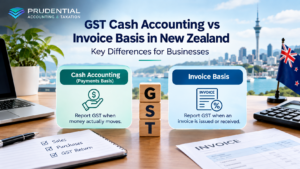
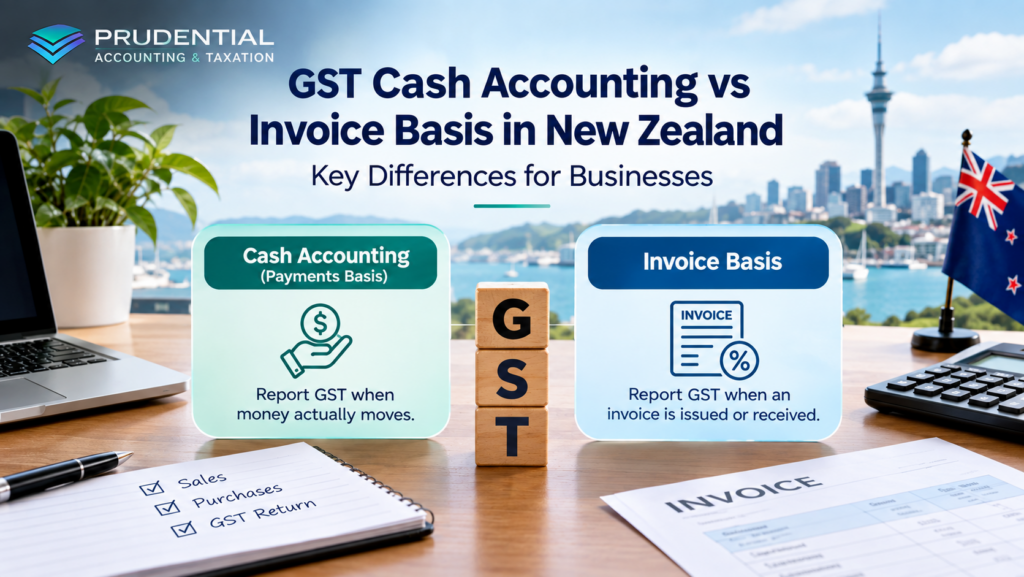
Under cash basis GST NZ, you account for GST only when money physically moves. Get paid by a customer, and that sale goes into the return covering the date payment landed. Pay a supplier, and you claim the GST in the period you paid them.
Picture a plumber who invoices $5,000 in January but the client pays in March. Under payments basis, that $5,000 doesn’t touch a GST return until March. No GST is owed until the cash is actually sitting in the account.
This is why most small operators prefer it. Your GST liability tracks your bank balance, not your invoicing calendar. It also cuts down on adjustments if a customer never pays at all, you simply never account for GST on income you didn’t receive.
How Does Invoice Basis GST NZ Work?
Under invoice basis GST NZ, GST is triggered the moment you issue an invoice or receive one from a supplier, regardless of payment timing. If you invoice a client $20,000 in June and they pay in August, the GST on that sale belongs in the June return.
This cuts both ways. You also get to claim input tax on supplier invoices the moment you receive them, even before you’ve paid the bill. For a business with strong debtor management and steady cash reserves, this can smooth out claims on big purchases like equipment or fit-outs.
The catch is obvious for anyone with slow-paying clients: you can end up owing GST on income that hasn’t landed yet, months before the customer settles up.
GST Cash Accounting vs Invoice Basis: What’s the Real Difference?
The core distinction in GST cash accounting vs invoice basis comes down to timing, not the amount of tax owed. Over the life of an invoice, the same GST gets paid either way. What changes is when.
- Payments basis: GST follows the bank account. No cash in, no GST owed yet.
- Invoice basis: GST follows the paperwork. An invoice issued is a GST event, paid or not.
- Cash flow risk: Higher on invoice basis if you carry large receivables or have customers who pay late.
- Admin load: Invoice basis usually needs debtor and creditor tracking at each period-end; payments basis doesn’t.
- Claiming expenses: Payments basis holds back your claim until you’ve actually paid the bill; invoice basis lets you claim as soon as the supplier invoice arrives.
For a contractor juggling 60-day payment terms, that difference can mean the gap between comfortably meeting a GST bill and scrambling to cover it from a business overdraft.
Who Can Use Which Basis?
Eligibility isn’t a matter of preference alone, turnover sets the rules.
- Turnover under $2 million: You can choose either payments or invoice basis when you register.
- Turnover over $2 million: Invoice basis becomes compulsory, though you may apply to IRD to stay on payments basis if your income is largely cash-based.
- No choice made at registration: IRD defaults you to invoice basis automatically.
- Already registered and want to switch: You can request a change in myIR, though the new basis only applies from the start of your next taxable period.
If you don’t actively pick a basis when you register for GST, you’ll end up on invoice basis by default, which is exactly the wrong outcome for a small business relying on cash flow to survive slow-paying clients.
Is There a Middle Option, the Hybrid Basis?
Yes, though it’s the least common of the three GST accounting methods NZ businesses use. Under the hybrid basis, you account for sales using invoice rules but claim expenses using payments rules.
In practice, this means you pay GST on invoices you’ve issued, whether or not you’ve been paid, but you only claim back GST on bills once you’ve actually paid them. For most small businesses, that’s the worst combination for cash flow, GST goes out early, but claims come in late. It’s rarely recommended outside specific structures where it genuinely suits the business model.
How Do You Change Your GST Accounting Basis?
Switching the GST accounting basis isn’t instant, and it isn’t retrospective either.
- Log into myIR and request the change under your GST account.
- IRD applies the new basis from the start of your next taxable period, not the current one.
- A wash-up adjustment is usually required, for example, moving from invoice to payments means calculating GST on outstanding debtors so nothing is double-counted or missed.
- Your accounting software (Xero, MYOB, or similar) needs to be updated to match the new basis, or your returns won’t reconcile.
This is the step most business owners get wrong on their own. A wash-up adjustment calculated incorrectly can trigger a mismatch that IRD flags months later.
Get Your GST Basis Checked Before Your Next Return
If you’re not sure which basis you’re on, or whether it still suits your business as it’s grown, it’s worth a five-minute conversation before your next filing deadline. Prudential Accounting handles GST registration, basis reviews, and switch-over adjustments for businesses across Auckland and beyond, for the gst filing services and we’ll tell you straight whether you’re on the right one.
Final Word
Getting GST cash accounting vs invoice basis wrong doesn’t show up as a compliance letter, it shows up as a cash flow squeeze you didn’t see coming. If you’ve never checked which basis you’re registered under, or you’ve grown past the point where your original choice still makes sense, that’s worth fixing before your next return is due. Talk to Prudential Accounting and get a straight answer on where you stand.
Faqs
Can I switch from invoice basis to cash basis GST NZ at any time?
Yes, you can request the change through myIR. It takes effect from your next taxable period, and you’ll need to complete a wash-up adjustment for outstanding invoices first.
Will changing my GST basis affect how much tax I pay overall?
No. The total GST paid over time stays the same either way. Only the timing of when it’s due changes, which is what affects your cash flow.
What happens if I go over $2 million in turnover while on payments basis?
You’re required to move to invoice basis (or apply for an exception if your income is mostly cash-based). IRD will expect the switch once your 12-month turnover crosses the threshold.
Is payments basis only for sole traders and small businesses?
It’s most common among smaller operators, but any business under the $2 million turnover threshold can use it, including companies and partnerships.
Does my invoicing software decide my GST basis automatically?
No. Software like Xero or MYOB follows whatever basis you set up, but the actual registration decision sits with IRD. If the two don’t match, your returns won’t reconcile correctly.