Objective
This blog explains when GST registration becomes compulsory in New Zealand, what the registration process involves, and what your responsibilities look like from that point forward.
Key Takeaways
- You must register for GST once your turnover reaches $60,000 in any 12 months.
- Missing the 21-day registration window can cost you money you never even collected.
- Voluntary registration before the threshold often makes financial sense for growing businesses.
- Filing returns incorrectly or late brings penalties, neither is worth the risk.
- A qualified accountant helps you avoid the mistakes most business owners only discover after the fact.
Table of Contents
- What GST Is in Plain Terms
- When to Register for GST in NZ
- Businesses That Must Register Regardless of Turnover
- Should You Register for GST Voluntarily?
- The GST Registration Process, How It Actually Works
- What Changes After Registering for GST in NZ
- How GST Returns Work
- Errors That Cost Business Owners Money
- When to Get an Accountant Involved
- FAQs
1. What GST Is in Plain Terms
GST is a 15% tax on most goods and services sold in New Zealand.
When you are registered, you charge 15% on top of your sales and collect it from customers. That money is not yours, you hold it until you hand it over to Inland Revenue through your returns. On the flip side, you can claim back the GST you paid on legitimate business expenses.
That is the core of it. You collect from customers, pay on expenses, and settle the difference with Inland Revenue each filing period. The system is not complicated once you understand the flow, but the admin behind it needs to be done properly.
We at Prudential Accounting & Taxation see a lot of business owners come through who wish they had understood these basics earlier. Not because the rules are hard, but because small misunderstandings early on tend to compound over time.
2. When to Register for GST in NZ
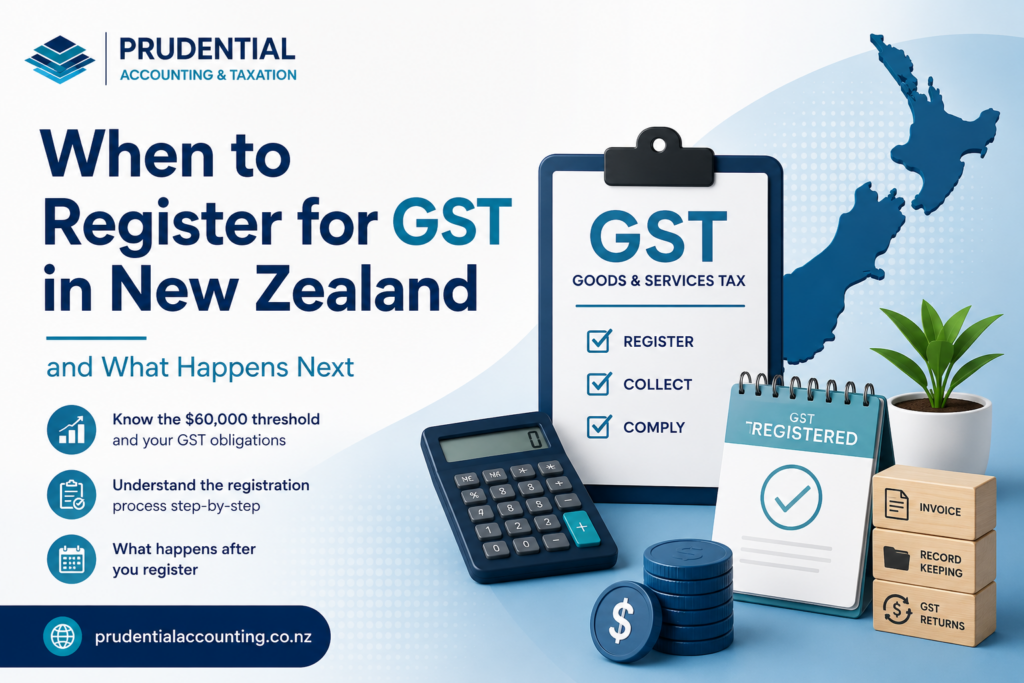
You are legally required to register for GST in NZ when your turnover hits $60,000 in any rolling 12-month period.
This is not the financial year. It is any consecutive 12 months. If your total sales from August last year to August this year reached $60,000, you have hit the threshold regardless of how the tax year sits.
The same rule applies in the other direction. If you have not yet hit $60,000 but you reasonably expect to in the next 12 months, a big contract signed, a major client confirmed, that expectation alone triggers the registration requirement.
Once you hit or expect to hit the threshold, you have 21 days to register. Three things about this window matter:
- The $60,000 figure is based on gross turnover, not what you took home after expenses.
- Both directions count, past sales and projected sales.
- If you miss the 21-day window, Inland Revenue backdates your registration anyway, meaning GST is owed on sales where you never charged it to anyone, so that shortfall comes out of your own pocket.
That third point is where businesses get hurt. The liability does not disappear because you missed the deadline. It just shifts entirely onto you.
3. Businesses That Must Register Regardless of Turnover
Some businesses have special GST rules, but the $60,000 threshold still applies in many cases. Always check the rule that applies to your business type before invoicing.
If you are a non-resident business supplying remote services or digital products to New Zealand consumers, you may need to register for GST once your supplies to New Zealand customers reach, or are expected to reach, NZ$60,000 in a 12-month period. Inland Revenue has extended these rules in recent years, and the obligations are real.
If you are unsure whether your particular setup carries any mandatory registration requirements outside the standard threshold, ask before you start invoicing. Assumptions in this area are expensive.
4. Should You Register for GST Voluntarily?
Voluntary registration, signing up before you reach $60,000, is an option, and many businesses take it.
The case for registering early:
- You can claim GST back on startup costs. Equipment, vehicles, software, fit-out costs, if you are spending money getting a business off the ground, being registered means that GST comes back to you instead of sitting as an unrecoverable expense.
- It signals credibility. Larger businesses often prefer suppliers who are GST registered. It suggests you are operating at a commercial level worth taking seriously.
- You get time to build your process. Registering before you have to gives you space to set up your accounting system, understand what records you need to keep, and get comfortable with the filing cycle, without a legal deadline sitting over you.
The honest counterpoint is that registration brings obligations. You must charge GST on all taxable sales. You must file returns. You must keep records. For a very early-stage business with minimal expenses and modest early revenue, waiting until the threshold is closer might genuinely be the more practical choice. It depends on your numbers.
5. The GST Registration Process, How It Actually Works
The GST filing services in Auckland runs through Inland Revenue’s myIR portal at ird.govt.nz.
Here is what to expect:
Step 1: Log in to myIR using your IRD number. If you do not have a myIR account yet, set one up first.
Step 2: Complete the GST registration form. You will enter your business name, IRD number, the nature of your business activity, and the date you want registration to take effect.
Step 3: Choose how often you will file returns. Options are monthly, two-monthly, or six-monthly. Businesses turning over more than $24 million must file monthly. For most small businesses, two-monthly is the default starting point.
Step 4: Choose your accounting basis. Invoice basis means GST is recorded when invoices are issued or received, regardless of payment. The $60,000 registration threshold is based on taxable activity turnover, not profit. Your accounting basis affects how you return GST after registration, not whether the threshold exists. The right choice depends on your cash flow situation.
Step 5: Once Inland Revenue confirms your registration, you receive your GST number, which may be the same as your IRD number. Use it correctly in your taxable supply information from your GST registration start date.
The process takes a few working days in most cases.
6. What Changes After Registering for GST in NZ
After registering, your taxable supply information must meet Inland Revenue requirements. For many taxable supplies over $200, this includes your business name, GST number, date, description, and GST payment information in an accepted format. You charge 15% on all taxable supplies. You track what you collect and what you pay throughout each filing period.
Pricing is a decision you need to make early. If you previously charged $200 for something, you now need to decide whether $200 includes GST or whether it comes on top. For GST-registered clients, it rarely matters, they claim it back. For unregistered consumers, it affects what they pay and, therefore, how competitive you are against non-registered suppliers.
7. How GST Returns Work
A return is the summary you file each period. GST collected minus GST paid on expenses. If you collected more than you paid, you owe Inland Revenue the difference. If you paid more, they will refund you.
GST returns are usually due by the 28th of the month after the taxable period. The main exceptions are the taxable period ending 31 March, which is due 7 May, and the taxable period ending 30 November, which is due 15 January.
Late filing attracts penalties. Underpayment attracts interest. Neither is a catastrophe if addressed promptly. Neither is worth making a habit of either.
Businesses that find returns straightforward are the ones that keep records current throughout the period. Businesses that struggle are the ones reconstructing months of transactions the week before the deadline.
8. Errors That Cost Business Owners Money
These are the mistakes that show up most often:
- Crossing the $60,000 threshold and not realising it until months later, by which point backdated GST is owed on sales where it was never charged.
- Charging GST on invoices before registration is confirmed, a compliance issue regardless of intent
- Claiming GST back on personal expenses run through the business account
- Applying the wrong accounting basis and filing returns that do not reflect actual obligations
- Issuing invoices post-registration without the GST number on them
None of these is a dramatic error. All of them are preventable. Most of them stem from not having a proper setup at the start.
9. When to Get an Accountant Involved in Your GST
For a business with straightforward revenue and clean expenses, managing GST independently is realistic. Most people work it out reasonably quickly after the first couple of filing periods.
Where it gets complicated is mixed supplies, some taxable, some exempt. Or international transactions. Or a backdated registration. Or an asset structure that creates GST implications on disposal. In any of these situations, the cost of getting it wrong is higher than the cost of getting proper help.
We at Prudential Accounting & Taxation work with New Zealand businesses at every stage, from first-time registration through to ongoing filing, compliance reviews, and handling Inland Revenue queries when they arise. Getting the foundation right at the start is always cheaper than fixing a problem that has been building quietly for two years.
If you have any uncertainty about whether you need to register now or how to set things up properly, the right time to ask is before you invoice, not after Inland Revenue writes to you.
Do Not Wait for a Problem to Find You. GST errors are easy to make and expensive to fix. Prudential Accounting & Taxation helps New Zealand business owners register correctly, understand their obligations, and stay on top of their compliance without stress. Talk to us before the deadline, not after it.
FAQs
Q1. What actually happens if I miss the 21-day registration window?
Inland Revenue backdates your registration to when you should have registered. GST then applies to all sales from that date, including the ones where you never charged it. That shortfall comes out of your own revenue. Penalties for late registration can also apply on top of that.
Q2. Is the $60,000 threshold based on what I invoice or what I actually receive?
It is based on turnover, meaning the value of taxable supplies made, not cash received. If you invoice $60,000 but only collect $45,000 in actual payments within the period, the threshold is still met under the invoice basis. Under the payments basis, only received amounts count, which is why the accounting basis choice matters.
Q3. Can I claim back GST on things I bought before I registered?
Sometimes yes. If you hold assets at the time of registration that are now used in your taxable business activity, you may be able to claim a portion of the original GST paid on them. The rules around this are specific to the type of asset and how it was acquired. Get advice before claiming incorrectly claimed GST creates issues during any Inland Revenue review.
Q4. What is the practical difference between zero-rated and GST-exempt?
Zero-rated means GST applies at 0%, the supply is still in the GST system, and you can claim back GST on expenses related to it. Exempt means the supply sits entirely outside GST, no GST charged, and no GST claimable on related costs. For businesses with a mix of both, calculating the right claimable portion of expenses requires care.
Q5. How do I choose between monthly, two-monthly, and six-monthly filing?
Monthly suits businesses that regularly receive GST refunds, frequent filing means faster refunds. Six-monthly suits smaller, simpler businesses with a turnover under $500,000 and minimal GST complexity. Two-monthly is the default for most and works well for the majority of small businesses. Your accountant can confirm which option fits your cash flow and compliance situation.
Q6. What do I need to do with GST if I close my business?
You must cancel your GST registration with Inland Revenue. At the point of cancellation, GST may be payable on the market value of any assets the business still holds, this catches people off guard. A final return must be filed and any outstanding balance settled before the registration closes.