Objective
This blog is written for New Zealand business owners, sole traders, and company directors who want to stay on the right side of Inland Revenue. The goal is simple: highlight the tax filing errors that cost Kiwi businesses real money every year, and give you the clarity to avoid them before your next return is due.
Key Takeaways
- Record every income stream as it is earned or received, and make sure it is reported in the correct tax return period.
- Apply IRD’s deductibility test to every expense before claiming it
- Review GST processes quarterly to catch errors before they accumulate
- Keep records for a minimum of seven years in an organised, accessible format
- Verify the correct employment status of everyone working with your business
- Track every tax deadline on a calendar and review it monthly
- Engage a qualified accountant; the fees are deductible and the savings are real
- Read your return before you sign it, every single time
Table of Contents
- Not Reporting Every Income Stream
- Claiming Expenses That Do Not Qualify
- GST Errors That Quietly Accumulate
- Poor Record Keeping Habits
- Misclassifying Employees as Contractors
- Missing Filing and Payment Deadlines
- Handling Tax Without Professional Support
- Submitting Without a Final Review
- Conclusion
- Frequently Asked Questions
Introduction
Tax season has a reliable way of exposing problems that stayed hidden the rest of the year. A missing receipt here, a miscategorised expense there, and suddenly a penalty notice from Inland Revenue arrives that nobody saw coming. Having worked closely with NZ businesses across multiple industries, the same errors surface year after year, and almost every single one of them was preventable.
This is not about complex tax strategy or advanced financial planning. It is about the practical, day-to-day common tax filing mistakes that quietly take money out of businesses that are otherwise running well. If any of the issues below sound familiar, the time to act is now, not at the end of March.
1. Not Reporting Every Income Stream
Most business owners report their main revenue without issue. The problem is smaller or irregular income that slips through. A short-term consulting project, a one-off payment from a former client, rental income from a business property, or money received through an online platform can all go unreported, not out of dishonesty, but simply because they did not fit the usual routine.
Inland Revenue does not only assess what you report. They cross-reference data from banks, payment processors, and third-party platforms. When the numbers do not match, it triggers scrutiny. The fix is straightforward: treat every dollar entering the business as something worth recording at the moment it arrives, not something to sort out later.
2. Claiming Expenses That Do Not Qualify
Overclaiming deductions is one of the most common tax filing mistakes accountants see across New Zealand. It rarely starts deliberately. Business owners grow comfortable claiming certain costs and stop checking whether those costs genuinely meet IRD’s criteria.
What the Rules Actually Say
An expense must be incurred in the course of earning income to qualify as deductible. Mixed-use items need careful handling. A vehicle used for both personal and business travel cannot be claimed in full. A home office claim must reflect the actual proportion of space used for work, not an estimate that happens to look convenient.
Claiming the full household power bill because you occasionally take calls at home is filing tax incorrectly, and IRD is well practised at identifying inflated home-office deductions. Keep receipts, maintain a vehicle logbook where relevant, and document the business purpose of significant expenses at the time you spend the money. Memory is not a record.
3. GST Errors That Quietly Accumulate
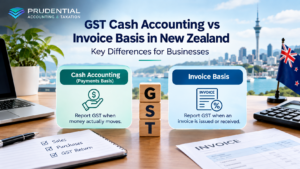
GST is one of those obligations that feels straightforward until the errors start to compound. For businesses registered for GST, two things need to be accurate on every return: what you claim back, and what you charge.
Common GST Traps to Watch
- Claiming GST on wages, which are not a taxable supply and carry no GST component
- Claiming GST on exempt supplies, such as certain financial services where no GST has been charged.
- Including private or domestic expenses in your GST claim
- Miscalculating the GST portion on GST-inclusive amounts
- Underreporting GST collected on all taxable sales
Late filing and late payment sit on top of this. IRD charges use-of-money interest on overdue amounts, and that interest accumulates faster than most business owners expect. Reviewing your GST processes quarterly, separate from your annual accounts, is one of the more practical tax compliance tips worth acting on.
4. Poor Record Keeping Habits
Inadequate records sit behind a large proportion of common tax filing mistakes, and the consequences go beyond inconvenience. Inland Revenue can request records going back seven years. If you cannot produce invoices, bank statements, payroll documentation, or evidence supporting your claimed deductions, you may lose those claims entirely, even when the underlying spending was entirely legitimate.
The typical scenario is a business that spent money in good faith on genuine costs, but has nothing on file beyond a rough recollection. That does not hold up. Cloud-based accounting software connected to your business bank account removes most of the manual effort and keeps your records organised as you go. A proper system costs far less than the deductions you stand to lose without it.
5. Misclassifying Employees as Contractors
Good intentions offer no protection here. Some businesses structure working arrangements as contractor relationships to avoid the obligations tied to employment, including PAYE, KiwiSaver contributions, and entitlements under the Holidays Act. Others make the mistake without realising it.
How IRD Actually Decides
IRD looks at the nature of the working relationship, not the label on an agreement. A person who works set hours, uses your equipment, cannot subcontract the work, and depends primarily on your business for income is likely an employee regardless of what any contract states. Getting this wrong exposes your business to backdated PAYE, penalties, and interest across the full period of misclassification. This is one of the tax return mistakes NZ businesses tend to underestimate until the bill arrives. If there is any doubt about how to classify someone currently working with you, seek advice before the arrangement continues.
6. Missing Filing and Payment Deadlines
A late GST return by a few days, or a provisional tax payment delayed because of a tight week in the accounts, can feel minor at the time. IRD does not treat it that way. Late filing generates a penalty. Late payment generates use-of-money interest. Both accumulate if the issue is not resolved promptly.
New Zealand businesses carry multiple tax obligations across the year, including provisional tax instalments, GST returns, PAYE, and annual income tax filing. These due dates are staggered and do not automatically align with each other. A visible calendar with every relevant deadline reviewed at the start of each month is one of the simplest habits that prevents this kind of problem. Registering with a tax agent also provides an extended filing window, which removes some of the pressure around year-end.
7. Handling Tax Without Professional Support
Being hands-on is a quality most business owners are proud of. Tax is one area where that instinct can become expensive. The cost of correcting errors, responding to IRD queries, or managing an audit routinely exceeds the cost of getting proper advice in the first place.
A qualified accountant does more than prepare your return. They identify deductions you have not thought to claim, flag compliance risks before they develop into problems, and ensure your business structure is operating as efficiently as it should. Accounting fees are themselves deductible, which lowers the after-tax cost of professional support. Treating that support as an unnecessary overhead is one of the more consequential assumptions a business owner can make. Avoiding professional tax compliance tips is rarely the money-saving move it appears to be.
8. Submitting Without a Final Review
Rushing the last step is how careful people end up with mistakes in an otherwise accurate return. A transposed figure, a blank income line, or an incorrect IRD number can delay processing, prompt queries from Inland Revenue, or hold up a refund you are legitimately owed. None of these are serious on their own, but none of them need to happen.
Before submitting, check your return against the source documents beside you. Confirm every income stream appears and every deduction is backed by a record. If an accountant prepares the return on your behalf, read it yourself before authorising submission. You remain responsible for what is filed under your name or your entity.
Conclusion
These are not obscure technical errors requiring a specialist to understand. They are recurring, practical mistakes that affect businesses at every stage, from start-ups to established operators. Most of them trace back to three things: disorganised records, assumptions made without checking the rules, and leaving it all too late.
At Prudential Accounting, we work alongside New Zealand business owners to ensure their tax obligations are handled accurately, efficiently, and without unnecessary stress. Whether you want a second opinion on your current approach or prefer to hand the whole process over to someone you can trust, we are ready to help.
Frequently Asked Questions
Q1. What are the most common tax filing mistakes made by NZ small businesses? Unreported income, overclaimed deductions, and GST miscalculations are the most frequently seen errors across NZ small businesses.
Q2. How far back can Inland Revenue audit my business records?
Inland Revenue requires businesses to keep records for at least seven years from the end of the tax year or taxable period they relate to.
Q3. Is filing tax incorrectly the same as tax evasion?
Not necessarily. Filing tax incorrectly through honest error or oversight is treated differently from deliberate evasion, but penalties and interest still apply either way.
Q4. Can I fix a tax return after I have already submitted it?
Yes. You can request an amendment to a filed return through myIR, and it is always better to correct an error voluntarily than wait for IRD to find it.
Q5. When should I register my NZ business for GST?
GST registration becomes compulsory when your taxable activity turnover is at least $60,000 in the last 12 months, or you expect it to reach at least $60,000 in the next 12 months. Voluntary registration is available below that threshold if you carry on a taxable activity.
Q6. Are accountant fees tax deductible in New Zealand?
Yes. Fees paid for tax advice and return preparation are a deductible business expense, making professional support more affordable than it first appears.