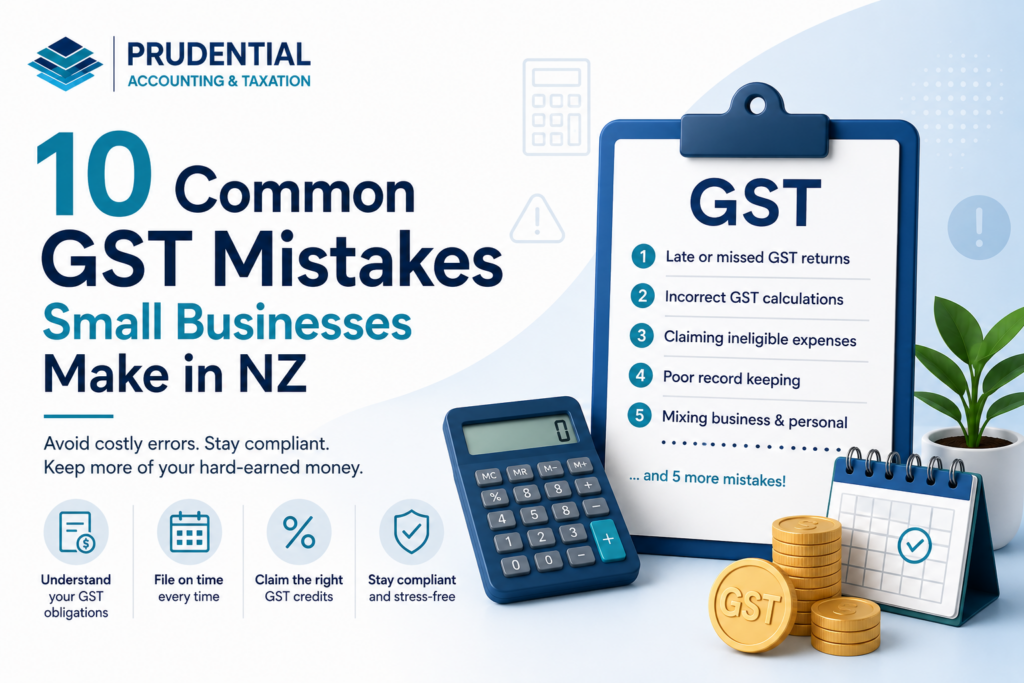
Objective: This blog walks through the ten most common GST mistakes small businesses make in New Zealand, why each one happens, and what you can do to avoid them before they cost you money.
Key Takeaways
- Most GST compliance mistakes are not deliberate: they come from misunderstanding the rules.
- GST return errors can trigger penalties, interest charges, and Inland Revenue audits.
- Avoiding GST penalties starts with clean records and a basic understanding of what you can and cannot claim.
- The same mistakes show up repeatedly: knowing them in advance keeps you off the list.
- Getting professional help early is far cheaper than fixing errors after the fact.
Table of Contents
- Why Small Businesses Struggle With GST
- Mistake 1: Missing the Registration Threshold
- Mistake 2: Claiming GST on Non-Business Expenses
- Mistake 3: Getting the Accounting Basis Wrong
- Mistake 4: Forgetting to File on Time
- Mistake 5: Charging GST Without Being Registered
- Mistake 6: Not Keeping Proper Tax Invoices
- Mistake 7: Claiming GST on Exempt or Zero-Rated Supplies
- Mistake 8: Getting the GST on Second-Hand Goods Wrong
- Mistake 9: Errors When the Business Has Mixed-Use Assets
- Mistake 10: Ignoring Adjustments When Circumstances Change
- FAQs
1. Why Small Businesses Struggle With GST
GST is not a complicated tax on paper. The problem is that running a small business leaves very little time to stay across the details and Inland Revenue does not adjust its expectations based on how busy you are.
Most common GST mistakes businesses make are not intentional. They come from assumptions, rushed admin, or a system that was never set up properly in the first place. The issue is that Inland Revenue applies the same rules to a sole trader turning over $70,000 as it does to a company turning over $7 million. The core GST obligations apply to all registered businesses, but penalties and filing details can vary depending on the situation and accounting basis.
We at Prudential Accounting & Taxation see the same errors coming through year after year. Not because business owners are careless but because nobody explained the rules clearly when they were starting.
2. Mistake 1: Missing the GST Registration Threshold
This is the most expensive mistake on this list.
The rule is that you must register for GST once your turnover hits $60,000 in any rolling 12-month period. The word rolling is what catches people. It is not the financial year. It is not January to December. It is 12 consecutive months.
Many small businesses hit $60,000 gradually, a few good months in a row and do not realise they have crossed the line until much later. By then, Inland Revenue can backdate the registration. GST becomes owed on past sales where it was never collected. That shortfall comes entirely out of your own pocket.
The fix is simple. Track your cumulative 12-month turnover every month. Set a reminder at $50,000. Do not wait until tax time to check.
3. Mistake 2: Claiming GST on Non-Business Expenses
GST can only be claimed on expenses that relate directly to your taxable business activity. Personal expenses put through the business account do not qualify and this is one of the most common GST compliance mistakes Inland Revenue looks for during reviews.
Examples that regularly cause problems:
- Groceries purchased alongside legitimate business supplies on the same receipt
- Personal vehicle costs are claimed in full when the vehicle is used privately
- Home internet claimed at 100% when only a portion is business-related
- Clothing that is not a uniform or protective equipment
The correct approach is to claim only the business portion. For mixed-use expenses, keep a record of the split and apply it consistently.
4. Mistake 3: Getting the Accounting Basis Wrong
When you register for GST, you choose either the invoice basis or the payments basis. The difference matters more than most people realise.
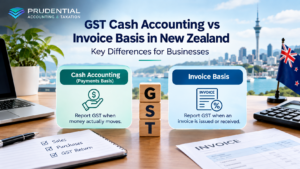
Under the invoice basis, GST is recorded when invoices are issued or received, not when money changes hands. Under the payment basis, GST is recorded only when a payment is actually made or received.
The mistake is applying the wrong basis to transactions or switching between them without realising it. A business on an invoice basis that only records GST when cash arrives is filing incorrect returns. That creates GST return errors that carry penalties once Inland Revenue identifies them.
Check which basis you are on. Make sure your accounting software is set up to match it. If you are not sure which one you selected when you registered, log in to myIR and confirm it.
5. Mistake 4: Forgetting to File GST Returns on Time
GST returns are usually due by the 28th of the month after the taxable period. The main exceptions are the period ending 31 March, due 7 May, and the period ending 30 November, due 15 January. Missing a GST filing date can lead to a late filing penalty, although Inland Revenue may issue a warning in some cases where your recent filing history has been clean.
Late filing is one of the most avoidable GST penalties in the system. It does not require a calculation error or a misunderstanding. It just requires not filing.
Set a calendar reminder for every due date at least a week in advance. Even if your figures are not perfect, filing on time and amending later is better than filing late with perfect numbers.
6. Mistake 5: Charging GST Without Being Registered
If you are not GST registered, you cannot charge GST. Collecting it from customers while unregistered means you have taken money that was never legally yours to take, and you cannot pay it to Inland Revenue because you have no registration to file under.
This happens when business owners assume they are registered because they have an IRD number, or because they completed some paperwork they thought covered it. Registration is a separate step. If you are not sure whether you are registered, check myIR before your next invoice goes out.
7. Mistake 6: Not Keeping Proper Tax Invoices
To support a GST claim, you need proper taxable supply information or records that meet Inland Revenue’s GST requirements. A bank statement entry is not a tax invoice. For many purchases, especially taxable supplies over $200, you need enough taxable supply information to support the GST claim, including supplier details and GST information where required.
A valid tax invoice must show:
- Supplier details, GST number where required, date, description of the supply, and payment/GST information in an accepted format
- The supplier’s name and GST registration number
- The date of issue
- A description of the goods or services
- The GST amount is shown separately, or a statement that GST is included at 15%
Missing invoices mean missing claims. More importantly, if Inland Revenue reviews your records and your claimed valid documents cannot support GST, those claims are reversed, and penalties may follow.
8. Mistake 7: Confusing Exempt and Zero-Rated Supplies When Claiming GST on Expenses
Not everything carries GST. Financial services, residential rent, and donated goods sold by non-profits are GST-exempt. Exports are zero-rated.
The difference between exempt and zero-rated matters. Zero-rated supplies are still part of the GST system, GST applies at 0%, and you can still claim GST back on related expenses. Exempt supplies sit entirely outside GST, no GST is charged, and no GST can be claimed on costs associated with producing them.
Claiming GST on expenses related to exempt supplies is a common GST compliance mistake that creates discrepancies in returns. If your business has a mix of taxable, zero-rated, and exempt supplies, the way you apportion your input tax claims needs to be calculated carefully.
9. Mistake 8: Getting GST on Second-Hand Goods Wrong
If you buy second-hand goods from an unregistered seller, you can still claim a GST credit but the rules are specific, and many business owners either miss the claim entirely or calculate it incorrectly.
For eligible secondhand goods bought from a non-registered seller, the GST credit is generally calculated as 3/23 of the GST-inclusive purchase price, provided the goods are used in taxable activity and the required payment and record rules are met. The purchase must also be documented properly. This is a legitimate and often-missed entitlement, but claiming it incorrectly creates GST return errors that Inland Revenue will adjust.
10. Mistake 9: Mixed-Use Assets and Getting the Apportionment Wrong
Assets used for both business and private purposes: a vehicle, a phone, a home office, require apportionment. You can only claim the GST that relates to the business-use portion.
The problem is that many business owners either claim the full amount or estimate a split without any documented basis for it. Inland Revenue expects the apportionment to be reasonable, consistent, and supportable if questioned. A vehicle log, a data usage breakdown, or a workspace measurement all count as supporting documentation. A rough guess does not.
11. Mistake 10: Not Making GST Adjustments When Circumstances Change
GST is not a one-time calculation at the point of purchase. If something changes, you start using a business asset more for personal purposes, you sell an asset, you leave a partnership, adjustments to your GST position are often required.
These adjustment obligations are one of the most consistently overlooked areas in GST compliance. Avoiding GST penalties in this area requires either a strong working knowledge of the adjustment rules or an accountant who flags when a change triggers an obligation.
We at Prudential Accounting & Taxation review these situations as part of ongoing client work precisely because they tend to go unnoticed until a return is queried. A missed adjustment caught early is a minor correction. The same adjustment found by Inland Revenue two years later is a more serious issue.
Stop Guessing With Your GST. GST return errors and missed obligations cost New Zealand small businesses real money every year, usually money that was entirely avoidable. Prudential Accounting & Taxation helps you get your GST right from day one and keeps it that way. Talk to us before your next return, not after Inland Revenue does.
Stay GST Compliant and Avoid Costly Penalties
GST compliance doesn’t have to be stressful. At Prudential Accounting & Taxation, we help New Zealand businesses manage GST registration, prepare accurate GST returns, maintain compliant records, and avoid costly filing mistakes. Whether you’re a sole trader, startup, or growing business, our experienced accountants are here to keep your GST obligations simple and hassle-free.
Speak with a GST Expert TodayFAQs
Q1. How does Inland Revenue find out about GST return errors?
Several ways. Automated cross-matching picks up discrepancies between what you filed and what your suppliers reported. Significant variances between income reported for income tax purposes and GST returns also trigger queries. Desk audits and field audits happen across the business population regardless of size.
Q2. What is the penalty for filing a GST return late in NZ?
A late filing penalty applies immediately on the day after the due date. If the return remains unfiled, further monthly penalties accumulate. Interest also accrues on any unpaid GST from the due date. The total cost of consistent late filing adds up quickly compared to simply filing on time, even with imperfect numbers.
Q3. Can I fix a GST error I made in a past return?
Yes. You can correct past GST return errors by filing an amended return through myIR or by including the correction in your next return if the amount is small. Voluntarily correcting errors before Inland Revenue identifies them typically results in lower or no penalties. Waiting until you are asked is always the worst outcome.
Q4. Does GST apply to all the income a small business earns?
Most taxable business income in New Zealand attracts GST, but not all. Financial services, residential rental income, and some donated goods are exempt. Some supplies, such as many exports, may be zero-rated if they meet Inland Revenue’s conditions.” If your business earns different types of income, understanding which category each falls into affects both what you charge and what you can claim.
Q5. How long do I need to keep GST records in New Zealand?
Inland Revenue requires you to keep all business records, including tax invoices, for a minimum of seven years. This applies even if your business closes. Digital records are acceptable provided they are accessible and readable if Inland Revenue requests them.