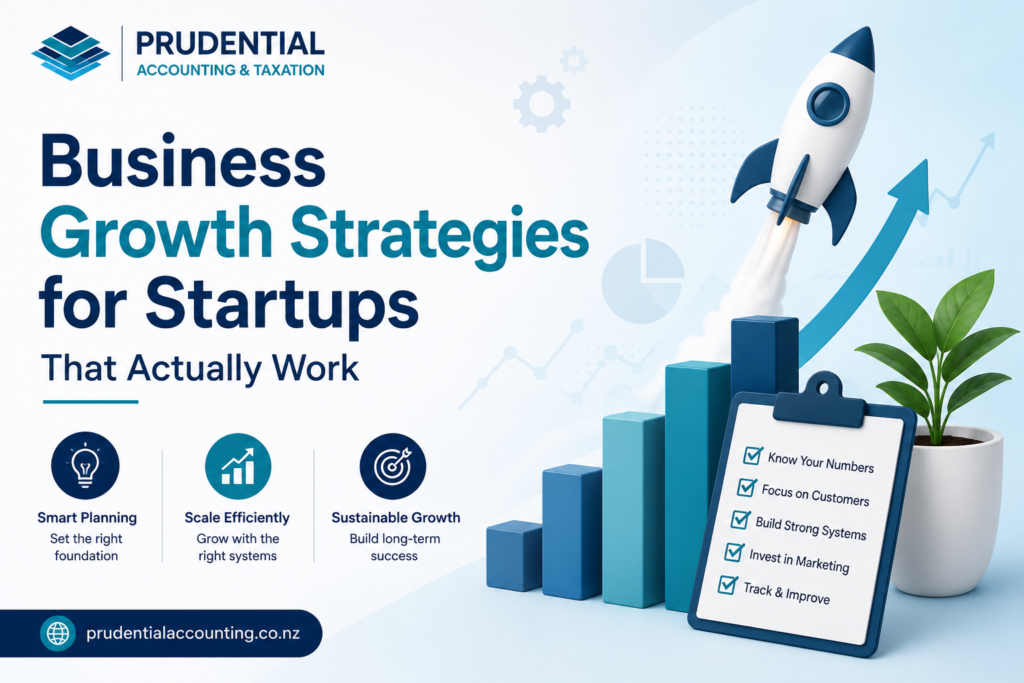
Objective: Give startup founders a practical, no-fluff framework for scaling their business in New Zealand, and position Prudential Accounting and Taxation as the advisory partner behind that growth.
Key Takeaways:
- Most startups don’t fail from a bad idea, they fail from scaling without a financial plan
- Business growth strategies for startups need to be built around cash flow, not just revenue targets
- Growth planning without accurate forecasting leads to overcommitment and cash shortages
- Startup scaling strategies work best when tax, payroll, and structure are sorted before growth, not after
- A professional advisor catches the gaps founders don’t have time to see themselves
Table of Contents
- Why Most Startup Growth Plans Fall Apart
- What Solid Business Growth Strategies for Startups Actually Look Like
- Startup Scaling Strategies That Protect Cash Flow
- Business Expansion Tips Before You Hire or Open a Second Location
- Growth Planning: Forecasting Before You Commit
- Where Professional Advice Changes the Outcome
- FAQ
A Papakura tradie we worked with landed three new commercial contracts in one month. Great problem to have, until he realised he’d need two more staff, new equipment, and a payroll system he didn’t have, all before the first invoice was paid.
That’s how most startup growth actually happens. Not a slow, tidy curve, but a sudden jump that outpaces the systems behind it.
Founders who scale well aren’t the ones with the biggest ambition. They’re the ones who had a financial plan sitting ready before the opportunity showed up.
Why Most Startup Growth Plans Fall Apart
Growth plans usually fail for one of two reasons. Either the founder never built one, and is reacting to opportunities as they come, or the plan exists but was never checked against real cash flow.
A construction client of ours had a solid pipeline of work booked for the next six months. On paper, growth looked certain. In practice, they were paying suppliers 30 days before client invoices cleared, and nearly ran out of working capital in the process.
Revenue growth and cash flow are not the same thing. Business growth strategies for startups only work when both are planned together.
What Solid Business Growth Strategies for Startups Actually Look Like
A working growth strategy answers three questions before anything else: what will this cost, when does the cash come in, and what happens if it takes longer than expected.
Start with your numbers, not your ambitions. Look at current margins, current overheads, and what changes when volume increases. Hiring one extra staff member doesn’t just add a salary, it adds PAYE obligations, holiday pay accrual, and often extra admin time that eats into billable hours.
Structure matters too. A sole trader taking on staff and signing bigger contracts often needs to move to a company structure for liability protection and tax efficiency. That decision should happen before growth, not scrambled through after a bad quarter.
Our Business Planning & Strategy service exists for exactly this stage, mapping the numbers before the growth, not cleaning up after it.
Startup Scaling Strategies That Protect Cash Flow
Scaling drains cash faster than most founders expect. Every new hire, every new location, every bigger contract needs money upfront, well before it returns anything.
Stagger commitments where you can. Taking on one new hire and proving the extra workload pays off, before committing to a second, protects you from overextending on a hunch.
Watch payment terms closely. A hospitality business we advise switched from 30 day supplier terms to weekly ordering once volume increased, which kept cash moving instead of sitting locked in stock.
Keep a cash buffer separate from growth capital. Founders who plough every available dollar into expansion have nothing left when a client payment runs late, and in our experience, one always does eventually.
Business Expansion Tips Before You Hire or Open a Second Location
Before signing a lease on a second site or bringing on staff, run the numbers on twelve months, not three. Early enthusiasm from a strong month rarely holds through a slower one.
Check your employment obligations properly. Employee contracts, minimum wage changes, and holiday pay rules catch out a lot of first time employers, and getting them wrong is expensive to unwind. Our Employee Contracts & HR Compliance service covers this before it becomes a problem.
Test demand before committing to fixed costs. A café client trialled weekend-only hours at a second Auckland site for three months before signing a full lease, which confirmed the location before the bigger commitment.
These business expansion tips sound obvious in hindsight. Most founders skip them anyway, because growth feels urgent and planning feels slow.
Growth Planning: Forecasting Before You Commit
Growth planning without forecasting is a guess dressed up as a strategy. You need to know what a loan, a new hire, or a second location actually costs across twelve to eighteen months, not just the sticker price.
This is where a lot of founders underestimate timing. A loan might fund equipment today, but repayments start immediately, while the extra revenue that equipment generates might take months to materialise.
Our Loan Forecasting & Financial Projections service models this out properly, so a borrowing decision is based on real numbers, not optimism.
Where Professional Advice Changes the Outcome
Founders are good at running their business. Most aren’t trained to read cash flow forecasts, structure a company for tax efficiency, or catch a payroll compliance gap before it becomes a Inland Revenue letter.
That’s not a criticism, it’s just not the job they signed up for. It’s why 15+ years of hands-on advisory work matters more at the growth stage than at the startup stage, when mistakes are smaller and easier to fix.
At Prudential Accounting and Taxation, we work alongside founders across construction, hospitality, trades, and dozens of other industries, building the financial side of growth so the operational side can move faster with less risk.
FAQ
When should a startup start planning for growth, not just survival?
As soon as revenue becomes predictable month to month. Waiting until growth is already happening leaves no time to plan the cash flow behind it.
Do I need a business plan if I’m already getting clients without one?
Getting clients and scaling profitably are different problems. A plan becomes essential the moment you’re considering hiring, borrowing, or opening a second location.
How much cash buffer should a growing startup keep?
Most advisors recommend one to three months of operating costs, more if your industry has seasonal or irregular payment cycles.
Should I switch from sole trader to a company structure before or after scaling?
Generally before. Liability exposure and tax treatment both change once you’re carrying more staff, contracts, and risk, and switching mid-growth is more disruptive.
Can Prudential Accounting help with the whole growth process, not just tax?
Yes. Growth planning, forecasting, structure, payroll compliance, and tax all sit under one advisory relationship, which is how most of our long-term clients work with us.
Final Thoughts
Growth exposes whatever wasn’t planned for. Cash flow gaps, payroll mistakes, structure problems, all of it shows up faster once volume increases.
Talk to Prudential Accounting and Taxation about our professional business plan services before your next big opportunity lands, not after.