Objective
Help Auckland business owners understand the practical difference between fixed fee accounting and traditional hourly billing, so they can choose a pricing structure that protects their cash flow and doesn’t punish them for asking questions.
Key Takeaways
- Fixed fee accounting gives you one agreed price before work starts, not an estimate that moves later.
- Traditional accounting fees are billed by the hour, so the final invoice depends on how complicated the month was.
- Fixed price accounting suits businesses that need ongoing support and want to budget properly.
- Hourly billing still has a place for genuine one-off jobs.
- Prudential Accounting and Taxation prices its packages around what a business actually needs, not a flat template.
Table of Contents
- What Is Fixed Fee Accounting?
- How Does Traditional Hourly Billing Work?
- Why Do Traditional Accounting Fees Feel Unpredictable?
- What Do You Actually Get With Fixed Price Accounting?
- When Is Hourly Billing Still the Right Choice?
- What to Check Before You Sign a Fixed Fee Agreement
- Fixed Fee vs Traditional Billing: A Side-by-Side Look
- FAQ
- Conclusion
We had a client, a hospitality business owner in Papakura, who used to dread opening her accountant’s invoice more than she dreaded tax season itself. One month it was $280. The next, after a payroll query and two phone calls, it was $760. She had no way to plan for that, so she started avoiding calls altogether. Small issues sat unresolved for months.
That’s the actual cost of hourly billing when nobody talks about it upfront. It’s not just the invoice total. It’s the fact that owners stop reaching out, and problems that could’ve been sorted in five minutes turn into bigger ones by the time the annual accounts get done.
More business owners are asking their accountant a direct question now: fixed fee, or hourly? It’s a fair question, and the answer changes depending on how your business runs day to day.
- Fixed fee accounting means one agreed price for an agreed scope, set before work begins.
- Traditional accounting fees are charged by the hour, so costs move with complexity.
- Fixed price accounting works well for ongoing needs like GST, payroll, and annual accounts.
- Hourly billing still fits isolated, one-off jobs.
- Prudential Accounting and Taxation builds fixed fee packages around real workload, not guesswork.
What Is Fixed Fee Accounting?
Fixed fee accounting is exactly what it sounds like. You agree on a price with your accountant before the work starts, and that’s what you pay, regardless of how many hours it actually takes on their end.
There’s no clock running. If a GST return takes longer than usual because your bookkeeping was messy that quarter, the price doesn’t change on you.
Most business owners we talk to like this because it turns accounting into a fixed overhead instead of a variable one. A builder juggling material costs and subcontractor invoices doesn’t need another unpredictable number on top of that.
At Prudential Accounting and Taxation, fixed fee accounting is set up around what a client actually does, not a one-size package. A freight operator filing GST weekly needs a different arrangement than a jeweller filing quarterly, and the pricing should reflect that difference honestly.
How Does Traditional Hourly Billing Work?
Traditional billing tracks time in blocks, often six or fifteen minutes, and charges for each block. Every email you send, every call you make, every file your accountant opens adds to the total.
Say your accountant charges $180 an hour. If it takes three hours to sort out a set of accounts because the records weren’t clean, that’s $540 before any actual tax work has been done. Clean books the following quarter might cost half that.
The hourly rate itself usually isn’t the issue. It’s not knowing what the final number will be until the invoice shows up.
Why Do Traditional Accounting Fees Feel Unpredictable?
Traditional accounting fees move based on how complicated your situation gets, and complications don’t usually give you advance warning.
A late supplier invoice. A payroll mistake picked up mid-month. An unexpected letter from IRD. Each one adds billable time you didn’t plan for, and they tend to show up together rather than one at a time.
There’s a knock-on effect too. When every question might cost money, owners stop asking. A small problem that should’ve been flagged early gets left alone until it’s an expensive one to fix. That’s the opposite of what an accountant should be doing for you.
What Do You Actually Get With Fixed Price Accounting?
Fixed price accounting takes the guesswork out of your monthly costs, and it changes how comfortable you feel picking up the phone. A few things that come with it:
- A cost you can actually plan for, since the amount leaving your account each month doesn’t move.
- No charge for asking a quick question, because a two-minute call isn’t treated as billable time.
- Easier forecasting, since a fixed cost drops straight into a budget without adjustment.
- Better communication with your accountant, since cost stops being a reason to hold back.
- Clear scope from day one, so there’s less back-and-forth about what’s included later.
One of our restaurant clients used to avoid calling her previous accountant about small GST issues because every call felt like it might cost her. Since moving to a fixed fee accounting arrangement with us, she checks in monthly without thinking twice about it. Her filings have been on time for two years running.
When Is Hourly Billing Still the Right Choice?
Hourly billing isn’t wrong in every situation. It fits work that’s genuinely a one-off and hard to scope properly in advance.
- Setting up a single company with no ongoing accounting relationship required.
- A one-time review after finding an error in old bookkeeping records.
- Urgent advisory work that falls outside your usual agreement.
For anything that repeats, though, like GST, payroll, or annual accounts, hourly billing rarely comes out cheaper than fixed price accounting once you add it all up over a year. There’s no ceiling on what it can cost you.
What to Check Before You Sign a Fixed Fee Agreement
Not every fixed fee offer is actually fixed. Some firms quote a low price upfront and then bill extra for anything that falls outside a very narrow scope. Before you sign anything, ask:
- Does the quote spell out exactly what’s included, service by service?
- Are basic IRD queries covered, or do those get billed separately?
- What happens to the price if your transaction volume grows during the year?
- Is there a clear process for handling scope changes, so nothing catches you off guard?
A firm that’s confident in its pricing will walk you through all of this before you sign, not after your first invoice lands. Prudential Accounting and Taxation sets out scope and cost upfront so clients know exactly what they’re paying for from the start.
Fixed Fee vs Traditional Billing: A Side-by-Side Look
| Factor | Fixed Fee Accounting | Traditional Hourly Billing |
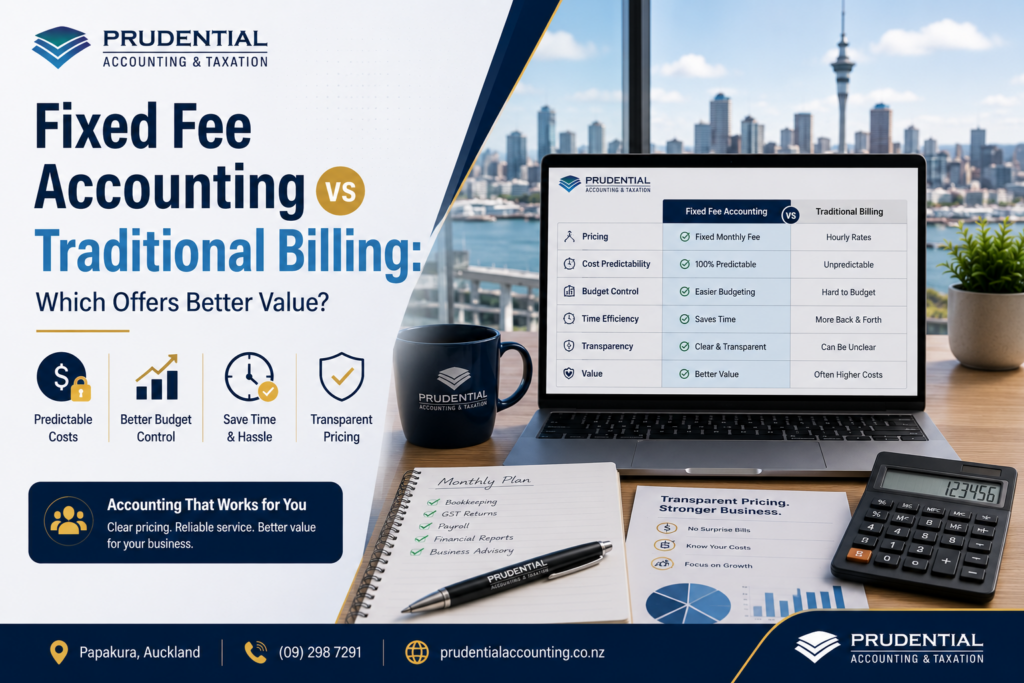
| Cost predictability | Set price, known in advance | Varies with hours logged |
| Budgeting | Straightforward, fixed monthly figure | Harder, fluctuates month to month |
| Comfort asking questions | Higher, no charge per call | Lower, owners tend to hold back |
| Best fit | Ongoing work — GST, payroll, accounts | One-off, isolated jobs |
| Invoice surprises | Rare, scope agreed upfront | Common during complex periods |
| Working relationship | Tends to be more open | Often more transactional |
FAQ
1. Is fixed fee accounting more expensive than hourly billing?
Usually not once you total it over a year. It can look like a bigger number upfront, but most businesses come out ahead once you factor in what a busy or complicated month would’ve cost under hourly billing.
2. Can I move from hourly billing to fixed fee accounting partway through the year?
Yes. Most firms, including ours, can move you across at your next service period once we’ve confirmed the scope of what you need.
3. Does fixed price accounting include urgent IRD queries?
That depends on the agreement, so it’s worth checking. At Prudential Accounting and Taxation, standard IRD correspondence is included in most fixed fee packages, but confirm this with any firm before signing.
4. What happens if my business grows and needs more accounting support?
Your fixed fee gets reviewed and adjusted to match the new scope. You won’t get charged retroactively for growth you couldn’t have planned around.
5. Is fixed fee accounting only suited to small businesses?
No. Sole traders, growing SMEs, and larger operations all use it. The pricing scales with what work you actually need, not with how big your business is.
Conclusion
Hourly billing can work fine for a single, isolated job. For anything ongoing, though, the unpredictability usually ends up costing more than it saves, in dollars and in the questions you stop asking because you’re worried about the bill.
Fixed fee accounting gives you a number to plan around and an accountant you can actually call without watching the clock.
If you want to see what a transparent, fixed price accounting setup looks like for your business, get in touch with Prudential Accounting and Taxation on (09) 298 7291, or take a look at our full range of services.