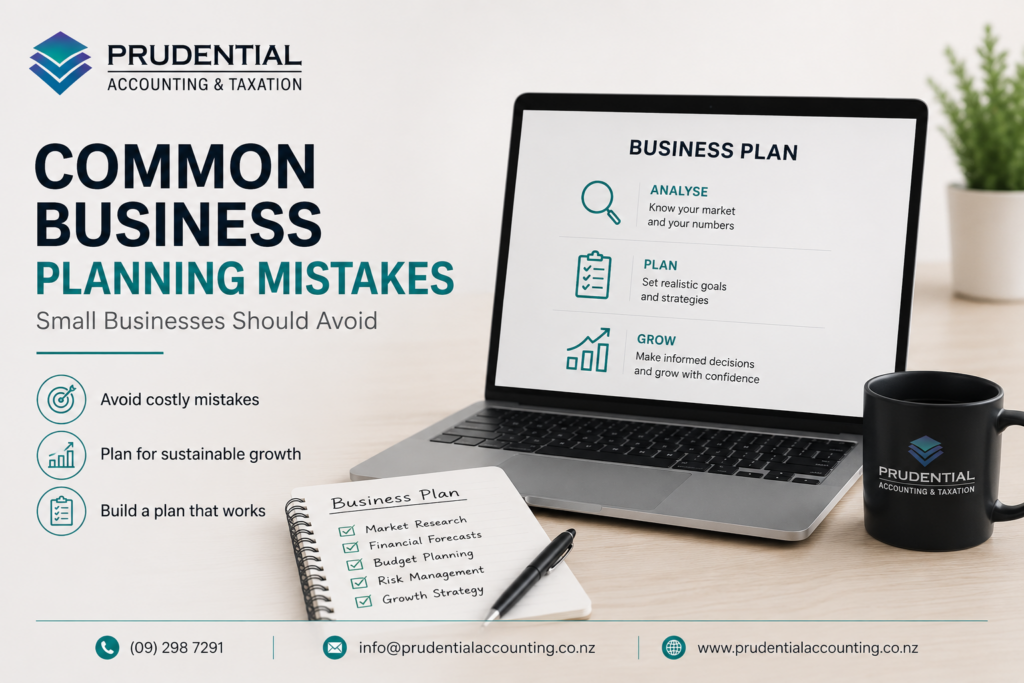
Objective
Help small business owners recognise the business planning mistakes that quietly stall growth, so they can build a plan that actually holds up once trading gets busy.
Key Takeaways
- Business planning mistakes usually show up months later, as a cash gap or a missed opportunity, not immediately
- Startup planning errors are almost always about assumptions, not effort
- Strategic planning mistakes often come from copying a template instead of building around actual numbers
- Business growth mistakes tend to happen when a plan doesn’t get revisited once trading starts
- A plan built with realistic numbers is worth more than one built to look impressive
Table of Contents
- What Counts as a Business Planning Mistake
- How These Mistakes Actually Happen
- The Most Common Business Planning Mistakes We See
- Startup Planning Errors Worth Watching For
- Strategic Planning Mistakes at the Growth Stage
- What a Solid Plan Actually Costs You
- FAQ
A café owner came to us with a business plan that looked polished. Nice projections, a five-year growth curve, all the right headings. What it didn’t have was a realistic view of staffing costs once the second location opened. Six months in, wages were eating margin the plan never accounted for.
This happens constantly. The plan wasn’t lazy. It was built around hope rather than numbers, and nobody stress-tested it before the lease was signed.
Business planning mistakes rarely show up on day one. They show up three, six, twelve months later, usually as a cash problem that traces straight back to an assumption nobody questioned.
Business planning mistakes usually come from unrealistic assumptions, templates that don’t match the actual business, and plans that never get revisited once trading starts. The fix is building around real numbers, testing assumptions early, and treating the plan as a living document, not a one-off exercise.
What Counts as a Business Planning Mistake
A business planning mistake is any gap between what the plan assumes and what the business actually needs to survive and grow.
That’s broader than people think. It’s not just missing a line item. It includes overestimating how fast revenue will ramp up, underestimating how long a market takes to respond, and building a plan nobody on the team actually refers back to.
The common thread: the plan stops reflecting reality, and decisions keep getting made against a version of the business that no longer exists.
How These Mistakes Actually Happen
Most planning mistakes aren’t about lack of effort. Owners spend real time on these documents.
The problem is usually where the numbers come from. A template pulled from a business planning guide gives generic industry margins and growth rates. Your business isn’t the average of that industry, and the plan needs to reflect your actual costs, your actual customers, and your actual market.
The second cause is timing. A plan gets built once, often to secure a loan or satisfy a business partner, and then filed away. Nobody checks it against what’s actually happening until something’s already gone wrong.
The Most Common Business Planning Mistakes We See
Skipping market research and feasibility analysis. Assuming demand exists because the idea makes sense on paper is a common trap. A proper feasibility check, even a basic one, catches gaps before money’s spent.
Underestimating operating costs. Rent, insurance, compliance costs, and staff on-costs get missed or underestimated constantly. These aren’t optional line items, and they add up faster than founders expect.
No contingency built in. Plans that assume everything goes to schedule fall apart the moment a supplier’s late or a big client pays slow. A buffer isn’t pessimism, it’s realism.
Growth targets with no operational plan behind them. A revenue goal without a plan for staffing, systems, or supply chain to support it is just a number on a slide.
Treating the plan as a one-time document. A plan built in January and never revisited is describing a business that no longer exists by June.
Startup Planning Errors Worth Watching For
Startups make a specific set of mistakes because they’re working without a trading history to check assumptions against.
Overestimating the ramp-up curve. Most new businesses take longer to reach steady revenue than the founder expects. Plans built on an aggressive month-three break-even rarely survive contact with the market.
Confusing a business plan with a pitch deck. A pitch deck sells a vision. A working plan needs to survive scrutiny from a lender or an accountant, not just impress a room.
Founders working in isolation on the numbers. Startup planning errors compound when nobody outside the founding team checks the assumptions. An experienced set of eyes catches unrealistic projections before they become the basis for a loan application.
No clear picture of financial forecasting and budgeting. A plan without a working cash flow view is a story, not a plan. This is where proper Business Planning & Strategy support earns its keep, building the plan around numbers that hold up under questioning.
Strategic Planning Mistakes at the Growth Stage
Growth brings its own set of strategic planning mistakes, different from the startup stage.
Scaling before systems are ready. Adding locations, staff, or product lines before operational processes can handle the load leads to service problems that damage the brand faster than growth builds it.
Ignoring risk assessment and management. A growth plan without a clear view of what could go wrong, supplier risk, key person dependency, cash flow exposure, leaves a business exposed right when it has the most to lose.
Chasing growth without checking margin. Revenue growth that comes with shrinking margin isn’t really growth. Business growth mistakes often trace back to chasing volume without checking whether each new sale is actually profitable.
No operational planning behind the strategy. A growth strategy needs an operational plan alongside it, covering staffing, process, and capacity, or the strategy stays a document instead of becoming a reality.
What a Solid Plan Actually Costs You
| Approach | Typical Cost | What You Risk |
| Generic template, filled in once | Low, mostly your own time | Numbers that don’t match your actual business |
| DIY plan, updated occasionally | Moderate time investment | Assumptions drift from reality between updates |
| Professionally built plan, reviewed regularly | Moderate ongoing cost | Realistic numbers, tested assumptions, ready for lenders |
The café owner from the start of this piece spent less fixing the plan with us afterward than the six months of margin the original mistake cost. Getting the assumptions right early is nearly always cheaper than correcting them once they’re already trading.
FAQ
How often should a business plan actually be reviewed?
At least every six months, and immediately after any major change, a new location, a new hire, a shift in the market. A plan that’s over a year old is usually describing a business that’s already moved on.
What’s the biggest business planning mistake you see with new businesses?
Overestimating how fast revenue will ramp up. Nearly every new business takes longer to reach steady trading than the founder originally planned for, and a plan without that buffer sets unrealistic expectations from day one.
Do I need a formal business plan if I’m not applying for funding?
Yes. A plan built around real numbers helps catch operational and cash flow problems early, funding application or not. It’s also the reference point for every major decision that follows.
Can you fix a business plan that’s already been built badly?
Yes. Most of what we do here is review an existing plan against actual trading data and correct the assumptions that don’t hold up, rather than starting from scratch.
What’s the difference between a business plan and a strategy?
A plan sets out the numbers and the steps to get there. A strategy is the broader direction, market position, competitive edge, growth approach, that the plan is built to support. Strategic planning mistakes usually happen when one exists without the other.
Conclusion
Business planning mistakes are rarely about effort. They’re about assumptions that never got tested and plans that never got revisited once trading started.
If your plan hasn’t been checked against your actual numbers recently, or you’re building one from scratch, contact Prudential Accounting for a review. Call (09) 298 7291 or email info@prudentialaccounting.co.nz.