Objective
Give small business owners a clear, practical framework for financial forecasting for small businesses, so they can plan cash flow, apply for funding, and make decisions with real numbers instead of guesswork.
Key Takeaways
- Financial forecasting for small businesses isn’t a once-a-year exercise, it’s a running picture you update monthly
- Cash flow forecasts and profit forecasts answer different questions, and most owners only build one of them
- Business financial forecasting works best when it’s based on your actual trading history, not industry averages
- Budgeting forecasts and cash flow forecasts should talk to each other, not sit in separate spreadsheets
- Lenders and investors expect forecasts built on realistic assumptions, not best-case scenarios
Table of Contents
- What Financial Forecasting Actually Means
- How Financial Forecasting Works in Practice
- Cash Flow Forecasting vs Budgeting Forecasts
- Forecasting Tips for Startups
- Common Forecasting Mistakes
- What Good Forecasting Costs You (and Saves You)
- FAQ
A client came to us last year needing a loan to cover a busy season order. He had the sales numbers. What he didn’t have was a forecast showing how the loan repayments would sit against his cash flow over the next six months. The bank asked for one, he didn’t have it ready, and the application sat waiting for three extra weeks.
That delay is common. Most small business owners track what happened last month. Very few have a working forecast of what’s coming next, and that gap shows up at the worst possible time, usually when they need funding or hit a cash squeeze.
Financial forecasting for small businesses isn’t complicated once you know what you’re actually forecasting and why. It just needs to be built properly, and kept current.
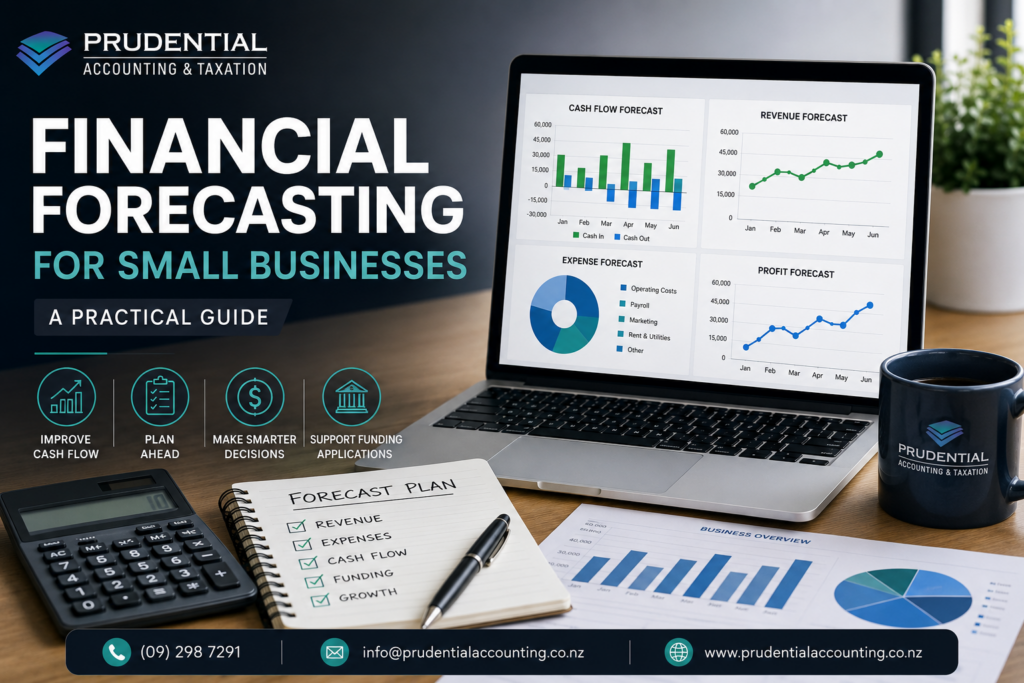
Financial forecasting for small businesses means projecting your cash flow, revenue, and expenses forward so you can spot problems before they hit and make funding or growth decisions with real numbers.
- Cash flow forecasts and profit forecasts answer different questions
- Forecasts should be based on your actual trading history, updated monthly
- Startups need shorter forecast windows and more conservative assumptions
- Lenders expect realistic numbers, not best-case projections
What Financial Forecasting Actually Means
Financial forecasting is the process of projecting your business’s future income, expenses, and cash position based on historical data and reasonable assumptions.
It’s different from a budget. A budget is a plan for what you intend to spend. A forecast is a prediction of what’s actually likely to happen, updated as real numbers come in.
Business financial forecasting typically covers three things: revenue, expenses, and cash flow. Miss one of these and you get an incomplete picture. A business can be profitable on paper and still run out of cash, which is exactly what a forecast is meant to catch before it happens.
How Financial Forecasting Works in Practice
Start with your actual trading history, not a template pulled from the internet. Twelve months of bank statements and sales data tell you far more than an industry benchmark ever will.
From there, build forward month by month. Include known seasonal patterns, such as a summer spike for a hospitality business or a quiet January for trades. Add planned changes, like a new hire or a lease renewal, with their actual cost and start date.
Update the forecast against actuals every month. This is the step most businesses skip. A forecast built once in January and never touched again is a guess by June, not a forecast.
Cash Flow Forecasting vs Budgeting Forecasts
These two get confused constantly, and treating them as the same thing causes real problems.
A cash flow forecast tracks money in and money out, by timing. It answers: will I have enough cash in the account on the 20th to cover payroll, even if a big invoice hasn’t been paid yet?
Budgeting forecasts, by contrast, project income and expenses over a period, usually monthly or annually, without worrying about exact timing. They tell you whether the business is on track overall, but they won’t warn you about a cash gap in week three of the month.
Both matter. A profitable budget forecast means nothing if the cash flow forecast shows you can’t cover wages before that big invoice clears. Our Loan Forecasting & Financial Projections service builds both together, so cash timing and overall profitability are never looked at in isolation.
Forecasting Tips for Startups
Startups face a specific problem: no trading history to forecast from. A few forecasting tips for startups that actually hold up in practice:
Use a shorter forecast window. Twelve months out is guesswork for a business with no track record. Three to six months, updated monthly, gives you something you can actually act on.
Build in a buffer for slower-than-expected sales. Most new businesses take longer to reach revenue targets than the founder expects. Model a conservative case alongside the target case, not just the optimistic one.
Separate one-off setup costs from ongoing costs. Lumping them together makes the early months look worse than the steady-state business actually is, which can spook a lender reading the numbers cold.
Get the assumptions reviewed by someone outside the business. Founders are often too close to their own numbers to spot an unrealistic growth assumption. This is where working with an accountant who’s seen a hundred similar businesses actually pays off.
Common Forecasting Mistakes
Forecasting revenue without forecasting cash timing. A signed contract isn’t cash in the bank. If your customers pay on 30-day terms, your forecast needs to reflect that lag, not the invoice date.
Copying last year’s numbers forward with a flat growth rate. Markets shift, costs rise, and a straight-line forecast rarely survives contact with reality.
Ignoring tax and GST obligations in the cash flow. GST owed to IRD is real cash leaving the business on a schedule. Forecasts that leave it out look healthier than the business actually is.
Building the forecast once and filing it away. A forecast is only useful while it’s being checked against actuals and adjusted.
What Good Forecasting Costs You (and Saves You)
| Approach | Typical Cost | What You Risk |
| DIY spreadsheet, built once | Low upfront, your own time | Stale numbers, missed cash gaps |
| DIY, updated monthly | Ongoing time cost | Better, but assumptions rarely stress-tested |
| Professional forecasting service | Moderate, ongoing or per-project | Realistic assumptions, ready for lenders and investors |
The businesses that come to us after a rejected loan application usually spent less on the forecast than the cost of the three-week delay that followed. Getting it built properly the first time is cheaper than fixing it under pressure.
FAQ
How far ahead should a small business forecast?
Most established small businesses forecast 12 months ahead, reviewed monthly. Startups or businesses in a volatile season are better off with a 3 to 6 month rolling forecast, since longer projections without a trading history tend to drift from reality quickly.
Do I need a forecast if I’m not applying for a loan?
Yes. Forecasting catches cash flow gaps and seasonal dips well before they become a crisis, loan application or not. It’s also what tells you whether a new hire or a lease is actually affordable before you commit to it.
What’s the difference between a forecast and a budget?
A budget is your spending plan. A forecast predicts what’s actually likely to happen and gets updated as real numbers come in. Businesses that only budget miss the early warning signs a forecast would catch.
Can you build a forecast if my bookkeeping is behind?
It’s harder, but not impossible. We usually start by getting your books current, since a forecast built on incomplete data is only as reliable as the numbers underneath it.
How often should a forecast be updated?
Monthly, at minimum, against actual results. A forecast that isn’t checked against reality every month stops being useful within a quarter.
Conclusion
Financial forecasting for small businesses isn’t about predicting the future perfectly. It’s about seeing problems and opportunities early enough to actually do something about them.
If you’re applying for funding, planning a busy season, or just want to stop guessing, contact Prudential Accounting for a forecast built around your actual numbers. Call (09) 298 7291 or email info@prudentialaccounting.co.nz.